When a serious CVE drops, the vulnerability gets all the fear. It is the thing with a score and a name, the thing your security team is already emailing about. So it feels like the vulnerability is the dangerous part.
Ask anyone who has run a fleet for a few years which one actually took production down, though, and a lot of them will name the patch. The update that was supposed to close the hole pulled in an incompatible library, or bumped a version something else quietly depended on, and the thing you did to get safe is the thing that woke you up at 2 AM. The bug was a risk. The change you made to fix it was a different risk, and it was the one you owned.
What stings about it is that the conflict was usually preventable. The information existed before the change ever reached a host. You just didn't get to look until it was live, when the only moves left are the bad ones.
CIQ Enterprise Linux Manager (ELM) is built to give you that look earlier. It is the fleet lifecycle management tool that comes with RLC Pro, and it does a lot across a fleet: it mirrors your content, curates it, provisions bare metal, and controls what every host is running. This post is about one thing it does especially well, which is making a change safe before you roll it out.
See the conflict before it ships
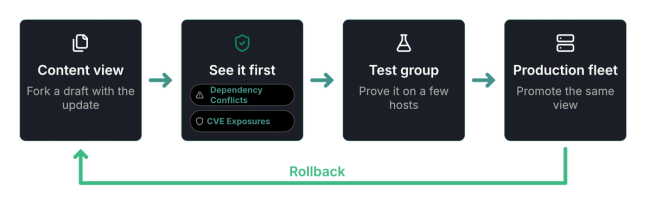
In ELM, what your hosts install is a content view: a named, versioned snapshot of exactly which packages and versions ship together. When you fork a new view to bring in an update, ELM runs a forward-only dependency check across it. The change maps forward through the view and the conflicts surface right there, on a draft you have not shipped, without re-walking the whole dependency tree every time.
So the incompatible library shows up while it is still cheap to deal with. You hold that package back, and ELM keeps the outstanding Common Vulnerabilities and Exposures (CVEs) visible on it, filtered by severity and Common Vulnerability Scoring System (CVSS) score. You are not trading a clean rollout for a blind spot. You can see the conflict you avoided and the exposure you are carrying on the version you held, and you make the call with both in front of you.
Prove it on a few hosts before the whole fleet
Seeing the conflict is half of it. The other half is not betting the fleet on being right.
ELM promotes a content view through stages you define, the familiar development to test to production path. You put the change on a small test group first, watch how it behaves on machines that look like production without being production, and only then elevate the exact same view up the chain. Nothing reaches the fleet on faith. It reaches the fleet after it has already run somewhere real and held.
That's the part that changes how the work feels. Rolling out stops being one held-breath moment that becomes a few controlled steps, each one reversible, each one telling you something before the next.
Ship exactly what you signed off on
When the view is right, ELM signs it at curation. The snapshot is immutable and the signature travels with it, so a host installs the content you approved and nothing that drifted in behind it. Every promotion lands in the audit log.
This is what turns a patching story into an answer for your security office. Not "we think the fleet is current," but a record of which signed, immutable version each host group runs, when it shipped, and who moved it there.
Get back to safe in one move
You will still get one wrong now and then. Everyone does. A change looks clean, clears the test group, and misbehaves in production for a reason nobody caught.
Rollback in ELM is a re-point, not a rebuild. Because every version is an immutable snapshot, getting back to a known-good state means pointing the host group at the prior one. It is immediate, and production is not waiting on a repository to rebuild while you sweat.
Where to take it next
Everything above is what the product does. The only test that matters is what it does on your fleet. No two content sets or change calendars look alike, so run your own through it.
The best version of that is not a canned demo. Instead, we’d love to have a conversation directly with you: about the content set you actually run, the change you are most nervous about, the migration you are weighing. That is the kind of thing our sales engineers can dig into with you. Start that conversation here.
Rather poke at it yourself first? Go deep on what ELM does.