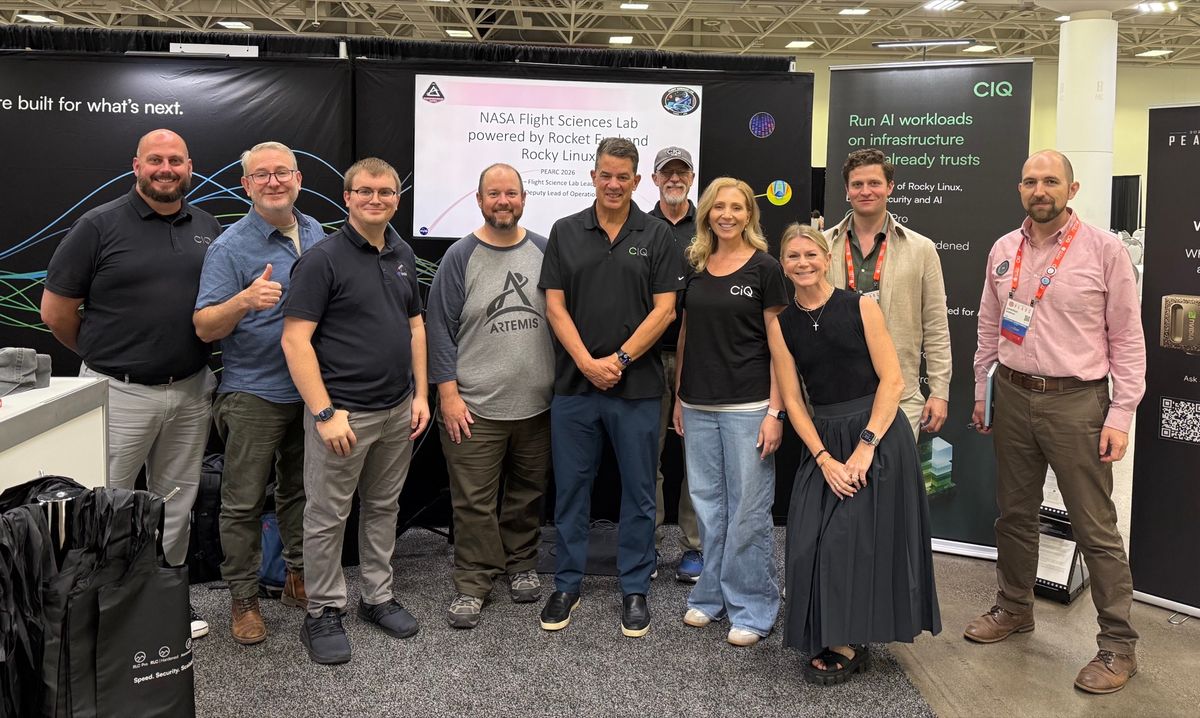
PEARC wrapped its tenth year in Minneapolis this week, and the theme organizers chose, Resilient Roots + Empowered Communities, turned out to describe the week better than most conference themes manage. This is not a conference where the biggest institutions dominate the conversation. It is one where a PhD student at a state university and a systems architect from a national lab are working the same problem from opposite ends, and both talk to us the same way.
We were at the CIQ booth running our NVIDIA DGX Spark giveaway, the same format we ran at ISC 2026 in Hamburg last month. Every Spark we give away ships with Fuzzball preinstalled. We came home with a winner, and with a much clearer picture of what the research computing community is actually trying to build.
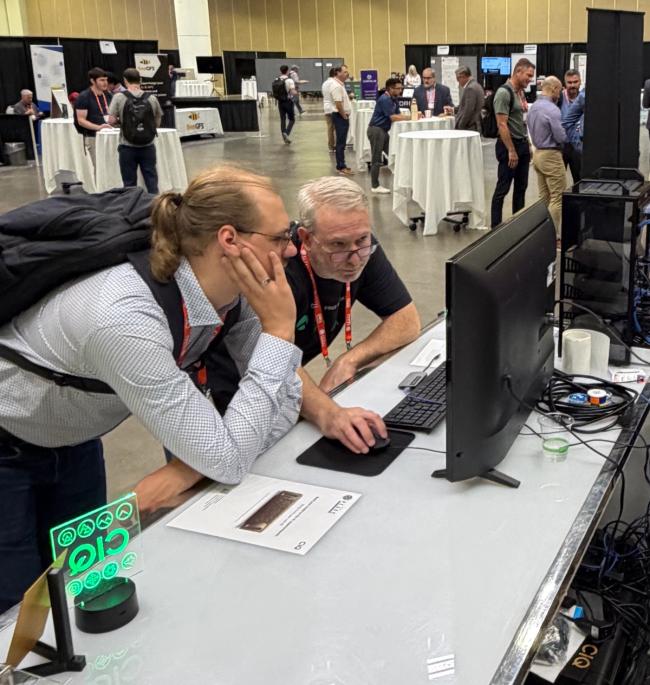
Ten years in, the community looks different than it used to
PEARC has always drawn a wider mix of people than the big supercomputing shows: research computing facilitators, campus IT staff, graduate students, and the people who keep university clusters running with a fraction of a national lab's budget. That mix was on full display this year. Entries to our giveaway came from flagship research universities, but also from the University of Guam, Grambling State, and community-facing arts programs. This spread is the actual story of research computing right now. The frontier is not only advancing at the handful of institutions with exascale budgets. It is advancing anywhere someone with a real problem gets access to compute they did not have last year.
What the community said it wants to build
Before the conference, we asked people to tell us what they would build with a DGX Spark preinstalled with Fuzzball. We received dozens of detailed responses, and reading through them told us more about the state of research computing than any keynote could.
Debugging and operating HPC is still mostly manual, and people want agents to help. A recurring submission described the same frustration: HPC systems are powerful but opaque, and diagnosing a failed job still eats hours of a researcher's week. Several entries proposed agents that watch job state, read logs, and recover or reschedule work without a human in the loop, with more than one researcher noting they needed Rocky Linux specifically because that is what production clusters actually run.
The desktop-to-cluster gap is the thing everyone is trying to close. Geospatial researchers, genomics teams, and simulation scientists described the same workflow again and again: prototype locally on a DGX Spark, then move the exact same pipeline to a university cluster or a national resource without rebuilding it. One researcher summed up the stakes plainly, calling that translation step between development and production the point where research workflows go to die. That is precisely the gap Fuzzball is designed to close.
Domain science is where the AI demand actually concentrates. The single biggest cluster of submissions was applied science: genomic foundation models aimed at precision oncology, drug candidate screening for Alzheimer's disease, agricultural suitability models pairing soil chemistry with real-time climate data, wildfire detection from drone and thermal imagery, and weather and disaster-response modeling. These were not speculative ideas. Most came from researchers already partway through the work, describing exactly where more local compute would remove their biggest bottleneck.
Access is still the limiting factor for a lot of good ideas. Multiple entries came from students and institutions with little or no existing access to this class of hardware, including a proposal to bring a first hands-on AI computing experience to University of Guam students, thousands of miles from the nearest large cluster. A PhD student described the DGX Spark as the single thing standing between her dissertation and the sample sizes her methods actually require. Community and education-focused entries, from research computing helpdesks to a campus-wide assistant for teaching HPC to new users, showed the same pattern: the tools people want most are the ones that make expertise easier to access, not just easier to produce.
The winner
From all the entries, Derek Weitzel of the University of Nebraska-Lincoln takes home an NVIDIA DGX Spark preinstalled with Fuzzball, with Brian Bockelman of the Morgridge Institute helping bring the submission across the finish line.
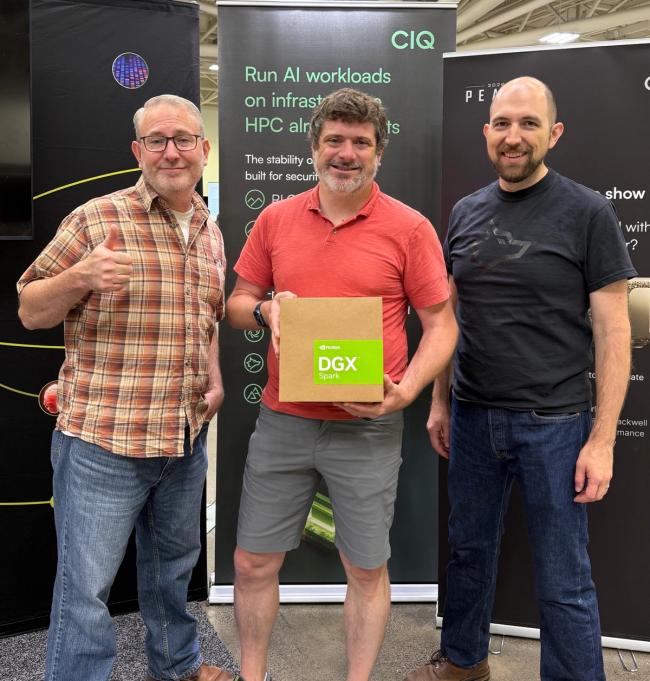
Derek's plan puts the Spark to work in two places at once. By day, it lives at UNL's Johnny Carson Center for Emerging Media Arts, where undergraduate film students learn to generate images and video with open-weights models instead of subscription APIs. Its 128GB of unified memory changes which models a nineteen-year-old film student can actually run, and having it on the studio floor instead of in a queue means iterating during a critique instead of overnight. Its first public outing will be the fourth annual AI Filmmaking Hackathon, where mixed teams of students, faculty, and the Lincoln community build a three-minute film in a single day.
Between classes and hackathons, the Spark joins NRP's Nautilus cluster as an opportunistic node, so its idle hours go to the 5,800 researchers and educators across 134 institutions that Nautilus already serves, run by the same team that operates 500 other NRP nodes. Fuzzball lets that same workflow move from the studio to the cluster without rebuilding it at each step.
It is hard to find a submission that captured the week's theme more directly: one box, serving an arts college by day and a national research network overnight, run by a small team stretching real capacity across a much bigger community than its budget would suggest.
The talk that packed our booth
The best-attended thing at booth 301 all week was not the giveaway. It was a booth talk from NASA's Johnson Space Center Flight Sciences Lab, given by Jeff Triplett, the lab's lead, and Tim Gregoire, its deputy lead of operations. By the time they started, the crowd had spilled past our booth space into the aisle, and people kept stopping to listen for the rest of the session.
Jeff and Tim walked through how FSL, which runs the analysis behind every crewed flight at NASA, operates one of the most mission-critical HPC environments anywhere, and why Rocky Linux is the foundation under it. They backed that up with specifics: a virtualization performance issue, a kernel scheduler regression, and a GPU graphics reproduction problem, each one a case where the depth of support behind Rocky Linux mattered as much as the operating system itself.
We are publishing a full recap of what Jeff and Tim shared, NASA's Flight Sciences Lab runs its most demanding missions on Rocky Linux, with more detail on each of those stories.
Jonathon Anderson took the stage twice
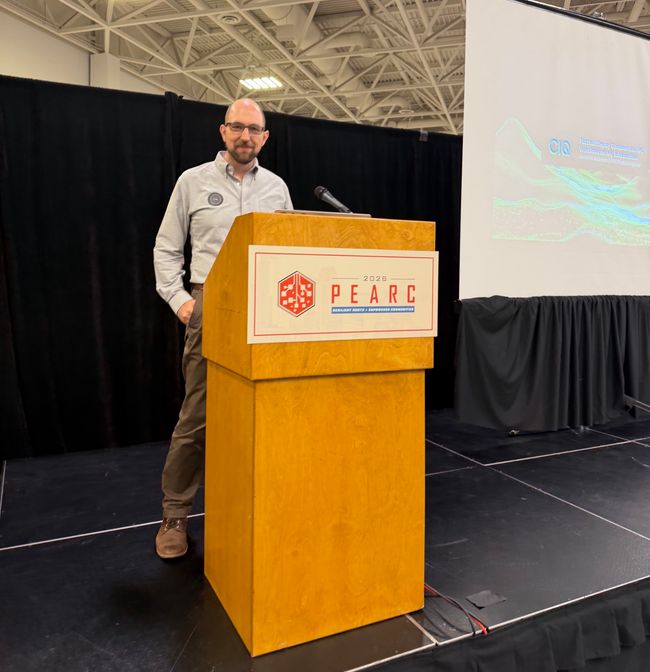
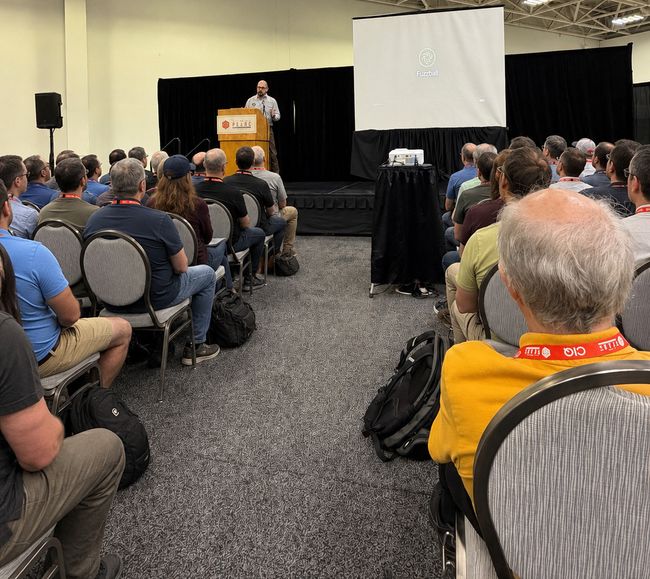
Our own Jonathon Anderson, principal HPC product engineer, had two sessions on Wednesday. At 1:30 PM, he and Rose Stein ran the Warewulf Community BoF, "Stateless Provisioning Evolves: IPv6, Provision-to-Disk, REST API, and What's Next," walking through where Warewulf Pro is headed on provisioning. At 3:10 PM, he gave a shorter session, "Eliminate the Migration Tax: Deploy Containerized HPC Workflows on Any Infrastructure," making the case for running the same containerized workflow anywhere without a rebuild at each step, the same theme that ran through nearly every submission to our giveaway.
What we heard on the floor
Beyond the submissions, the conversations at the booth reflected a community working through the same set of pressures from a lot of different starting points.
Budgets are the constant subtext. Nearly every conversation about AI infrastructure eventually turned into a conversation about what a campus or a lab can actually afford to run, own, and maintain, as opposed to what a cloud vendor is happy to sell them. Research computing teams are used to doing more with less, and that instinct is now shaping how they think about AI compute too. It is the same case our CEO Gregory Kurtzer made recently in the Dutch publication Technology Insider: bringing AI in-house takes more than a server rack, because running it in production means owning the entire stack, from the operating system to the orchestration on top of it.
The line between HPC and AI infrastructure keeps disappearing. Systems staff at PEARC are not managing separate HPC and AI environments. They are managing one heterogeneous environment and looking for orchestration that does not require different tooling or different expertise depending on the workload. That is the same shift we heard about at ISC, and it shows up just as clearly at a mid-sized, community-driven conference as it does at a national-lab-heavy one.
Students are a bigger part of this conversation than they used to be. PEARC's student program has grown alongside the conference, and it showed in the booth traffic: a steady stream of graduate students and even undergraduates asking specific, well-informed questions about running real workloads on hardware they might actually get their hands on. The next generation of this community is arriving with more hands-on experience than the last one did.
What comes next
The pattern across both PEARC and ISC this year was consistent: give researchers hardware and orchestration that travel with them from a desk to a cluster, and they will point it at real problems immediately. Nobody we talked to needed convincing that AI has a role in their work. What they needed was a way to get there without a cloud account, a support contract with a hyperscaler, or a rebuild every time the compute changes underneath them.
That is what Fuzzball on DGX Spark is built to remove. The path from a submission form to a working pipeline should not require more infrastructure than the idea itself.
CIQ is the founding commercial sponsor of Rocky Linux and the company behind Fuzzball, Warewulf Pro, Ascender Pro, and Apptainer. Learn more at ciq.com.