ISC High Performance wrapped last week in Hamburg, and the conversation on the floor was harder to ignore than usual. This was not a typical conference where the biggest news is a product refresh or a benchmark update. What happened at ISC 2026 felt like a marker: the moment the geopolitical stakes of compute infrastructure became impossible to separate from the technical ones.
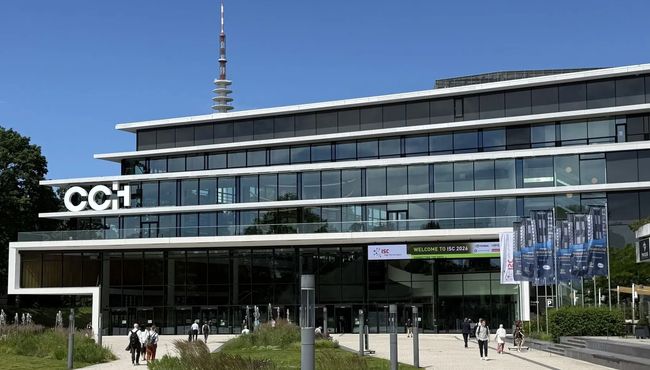
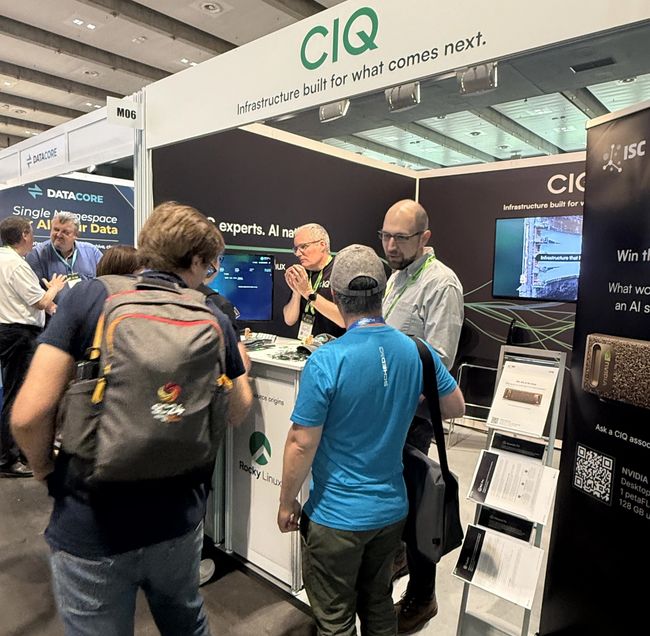
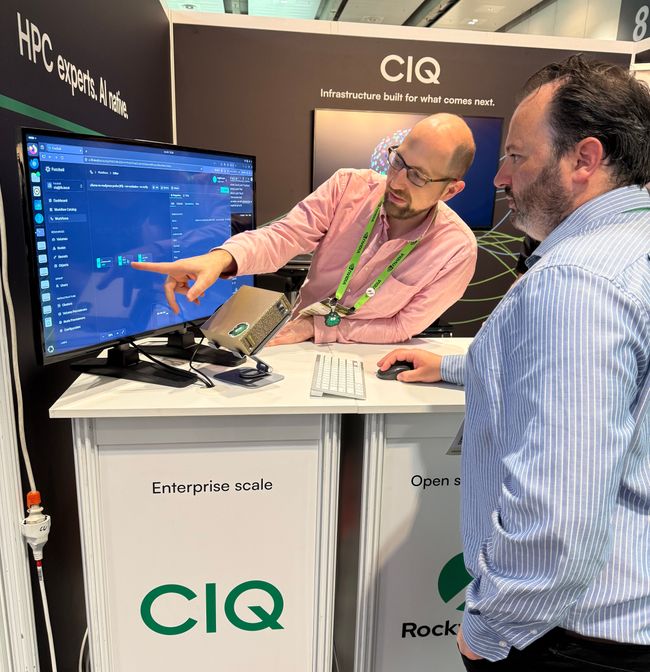
We were there at Booth M06, running our NVIDIA DGX Spark giveaway and announcing Fuzzball's support for the platform. But we came home with more than a press release and a winner. We came home with a clearer picture of what the research and HPC community actually needs, and why the infrastructure decisions being made right now matter far beyond any single organization.
The Top500 moment nobody fully expected
The 67th Top500 list was announced at ISC on June 22, and it set a tone for everything that followed. LineShine, installed at the National Supercomputing Centre in Shenzhen, debuted as the new number one system, delivering 2.198 exaflops on the HPL benchmark with nearly 14 million cores, all built on Chinese-designed processors, a proprietary interconnect, and Kylin OS. China last held the top spot in 2017. Jack Dongarra, a founder of the Top500, noted that trade restrictions forced China to invest heavily in its own hardware designs, and that investment led directly to this result.
That dynamic set the backdrop for everything else at ISC: export controls intended to constrain a competitor's progress can accelerate domestic innovation. The field is fragmenting by design, driven as much by geopolitics as by engineering, and the organizations that understand that are making different infrastructure decisions because of it.
The sovereign AI conversation is no longer theoretical
Coming into ISC, the policy context had already shifted significantly. Weeks earlier, the G7 convened in Evian with AI sovereignty as a central agenda item. The European Commission released its European Technological Sovereignty Package. And the US government issued an export control directive that led Anthropic to disable Fable 5 and Mythos 5 for all users, not just foreign nationals, because selective enforcement was not technically feasible at scale.
That sequence of events meant ISC attendees arrived in Hamburg having already absorbed the message that access to frontier AI is conditional. The question was what to do about it.
The European position is clarifying. The continent has significant HPC infrastructure, deep research institutions, and a policy appetite for action. JUPITER, the EuroHPC system at the Jülich Supercomputing Centre in Germany, holds the number five position on the Top500 and remains the first European exascale system. Sustaining that position and extending it into the AI era requires infrastructure that European institutions actually control, open, portable, and accountable to no vendor's policy decisions.
That is the space CIQ has operated in since its founding. Rocky Linux exists because the community needed an Enterprise Linux platform that could not be altered or discontinued at someone else's discretion. Fuzzball exists because researchers and engineers need AI workflow orchestration that runs consistently whether the compute is on-premises, at a national lab, or in a cloud, without rebuilding pipelines at each boundary.
What the community said it wants to build
Before ISC, we ran an open submission: tell us what you would build with a DGX Spark preinstalled with Fuzzball. We received hundreds of entries from researchers, engineers, students, and operators across Europe and beyond.
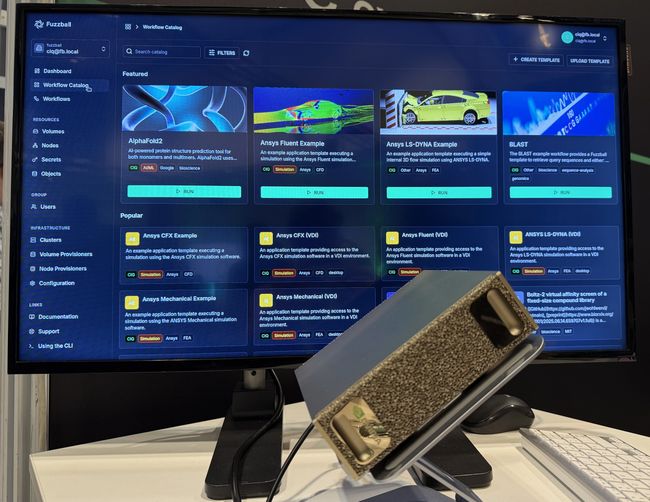
Reading through them was one of the more instructive things we did all quarter. The submissions were not just wish lists, they were working descriptions of real problems that compute access would unlock. A few patterns stood out.
The HPC knowledge problem. Multiple submissions described the same challenge: HPC systems are powerful but opaque. Tribal knowledge lives in scattered documentation, team notebooks, and the heads of people who have been around long enough to know. One researcher from a publicly funded center in Germany described building a retrieval-augmented assistant grounded in internal documentation, so anyone on the platform could ask how to run a specific workload and get a straight answer with sources, all on hardware that never leaves the facility.
AI for scientific computing. The majority of submissions were domain-specific. An Alzheimer's risk prediction pipeline built on UK Biobank data. Drug-target interaction models for accelerating medicine discovery. A neural network for real-time reconstruction of simulation fields in a CAVE visualization system, so scientists can explore their data interactively instead of waiting for full renders. Quantum trajectory simulations with sub-microsecond inference requirements for active quantum error correction. These are research problems that require AI-class compute, and the researchers describing them know exactly what they need.
Portability as a prerequisite. Across dozens of submissions, the Fuzzball use case was described the same way: train on HPC or cloud, fine-tune and run inference locally, with the same workflow throughout. Researchers working across institutional compute, national lab allocations, and cloud burst capacity need orchestration that does not require rebuilding pipelines at each boundary.
Infrastructure that works where connectivity does not. Several submissions described deployment contexts where reliable power and network connectivity are not guaranteed. This came up in the context of field research, edge deployments, and, most vividly, in the winning submission.
The winner
From hundreds of submissions, Martin O'Reilly from the Alan Turing Institute takes home an NVIDIA DGX Spark preinstalled with Fuzzball.
The Turing's FastNet and Cumulus projects use AI to build weather models with the UK Met Office and the national weather services of Ghana and Senegal. AI cuts the compute that physics-based simulation demands, which means faster, cheaper forecasts that are small enough to run on generator power when the grid goes down. For West African farmers, that translates to sub-seasonal predictions that answer a simple but critical question: when to buy seed and when to plant.
With Fuzzball, the same workflow can run from HPC and cloud training all the way through to inference on the Spark.
That is exactly the kind of work Fuzzball was built for.
The project connects almost everything ISC 2026 surfaced: the need for sovereign, in-country AI infrastructure; the value of compute that operates independently of cloud connectivity; the gap between what physics-based simulation demands and what a researcher can actually access; and the real-world stakes when the output is not a benchmark score but a forecast that tells a farmer whether to plant.
What we heard on the floor
Beyond the submissions and the Top500 announcement, the conversations at the booth and across the conference reflected a community that is actively reorienting around a new set of constraints.
European researchers and operators are thinking seriously about infrastructure ownership, in terms of concrete procurement and deployment decisions. Which software stack can an institution genuinely control, audit, and maintain if the vendor relationship changes? That question came up in nearly every serious conversation we had.
A related theme came up repeatedly in conversations outside the booth as well. The debate about whether the bottleneck has moved to the data and orchestration layer is settled. What people are working through now is how fast they can get there without inheriting a decade of operational complexity on the way. GPU access is becoming more distributed. The organizations that will run AI effectively are the ones that can provision, manage, and move workloads without rebuilding their stack every time the hardware configuration or cloud relationship changes. The HPC community has been solving exactly that problem for thirty years. The tools exist. The question is whether AI teams find them before they build something brittle from scratch.
The HPC and AI convergence is reshaping what "cluster management" means. The systems people at ISC are not managing separate HPC and AI environments anymore. They are managing hybrid workloads across heterogeneous hardware, and they need orchestration that does not require separate tooling, separate pipelines, or separate expertise for each environment. The interest in Fuzzball's unified workflow model, where the same orchestration layer moves from training to inference without rewriting, was consistent across every type of organization we spoke with.
Jonathon Anderson's session on OpenHPC, Warewulf, and Open CHAMI drew exactly the audience you would expect: people responsible for provisioning infrastructure at research institutions who are actively working through how to modernize cluster management without abandoning the open source foundations their environments depend on.
What comes next
The Fuzzball and DGX Spark announcement, formally published on June 30, makes the platform available to any organization that wants to run AI workflows on hardware they own and control. The path from submission to production does not require a cloud account or a support contract with a hyperscaler.
ISC 2026 was a reminder that the infrastructure decisions being made right now are not temporary. The organizations that build on open, portable, sovereign infrastructure today are the ones that retain the ability to operate independently when the policy environment shifts again. And based on what we saw in Hamburg, it will.
CIQ is the founding commercial sponsor of Rocky Linux and the company behind Fuzzball, Warewulf Pro, Ascender Pro, and Apptainer. Learn more at ciq.com.