Pulling from Google Artifact Registry with Fuzzball
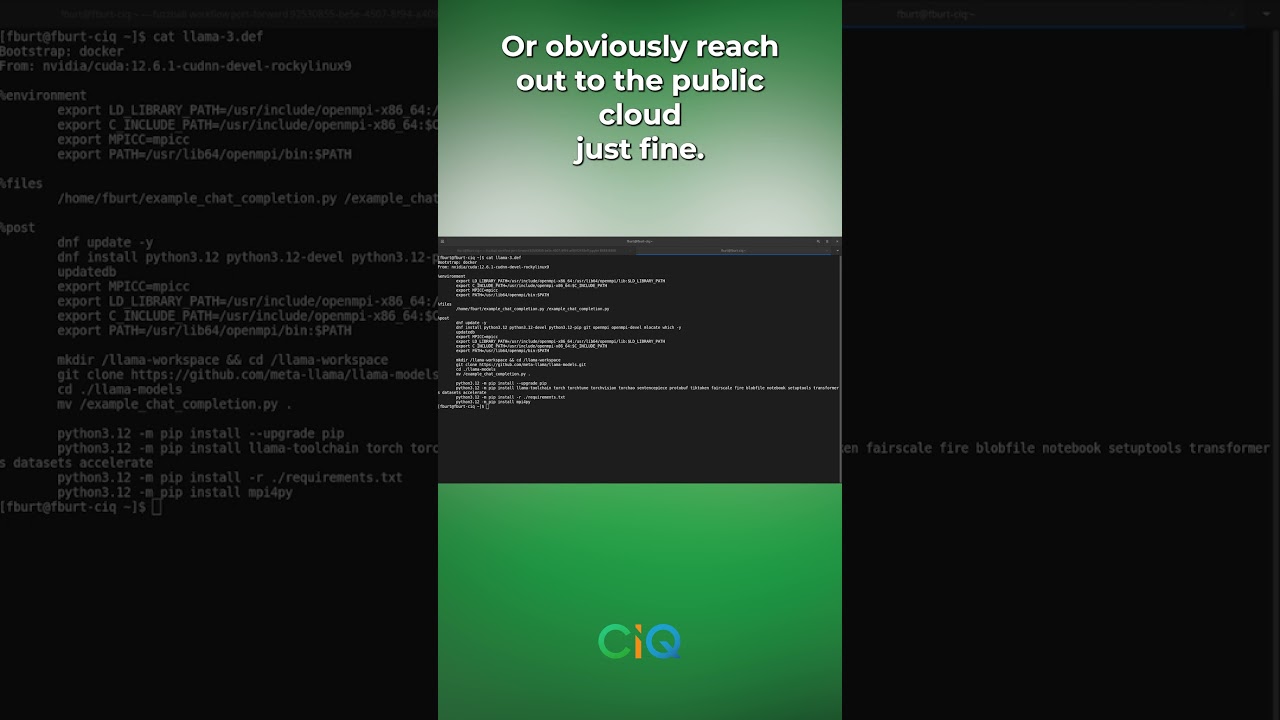
This quick demo pulls software down from Google Artifact Registry, one of the many places Fuzzball can fetch containers. Fuzzball supports most artifact registries, public or private, including Docker Hub and NVIDIA NGC, using whatever credentials each requires. Because Fuzzball was designed to run behind air gaps, it also integrates with air-gapped container registries.
The container image in question is a Python 3.12 environment the presenter assembled with MPI tooling, Llama model tooling, and the standard PyTorch stack used for these models: torch, torchtune, tokenizers, and Transformers. It is a compact look at how AI workloads get their software into Fuzzball.
Key takeaways
- Fuzzball can pull containers from Google Artifact Registry and most other public or private registries, including Docker Hub and NGC.
- Fuzzball was designed to run behind air gaps and integrates with air-gapped container registries.
- The demo container bundles Python 3.12 with MPI tooling, Llama model tooling, and PyTorch packages like torch, torchtune, tokenizers, and Transformers.
Questions this video answers
Which container registries can Fuzzball pull from?
Fuzzball supports most artifact registries, including Google Artifact Registry as shown here, Docker Hub, NVIDIA NGC, and private registries, using the credentials you supply. Because it was built for air-gapped sites, it also works with any air-gapped container registry you operate internally.
This video is part of the Fuzzball playlist. Browse every CIQ video by product and topic.
Transcript
in today's demo we're going to be pulling a bit of software down from the Google artifact registry which fuzzball supports as a place to get containers from in general most artifact Registries fuzzball supports so if you've got containers out in the cloud on something public something private Docker NGC Etc you can utilize whatever credentials you need to get into that um or obviously reach out to the public Cloud just fine Fuzzball was designed for to be run behind air gaps so this also fully integrates with any type of airgap container registry you might want um but just in this case to show you what we're
pulling from this is a quick little python 3.12 enabled container that I've put together with some MPI tooling some llama model tooling uh a few different bits of standardized pytorch info and packages that we utilize for these pytorch based models so torch torch tune um some uh tokenizers Transformers of course the classic all that
Built for scale. Chosen by the world’s best.
2.75M+
Rocky Linux instances
Being used world wide
90%
Of fortune 100 companies
Use CIQ supported technologies
250k
Avg. monthly downloads
Rocky Linux
9
Enterprise products
Spanning the kernel to the orchestrator
Have questions about your infrastructure?
Talk to a CIQ engineer about Rocky Linux, HPC, and AI infrastructure.