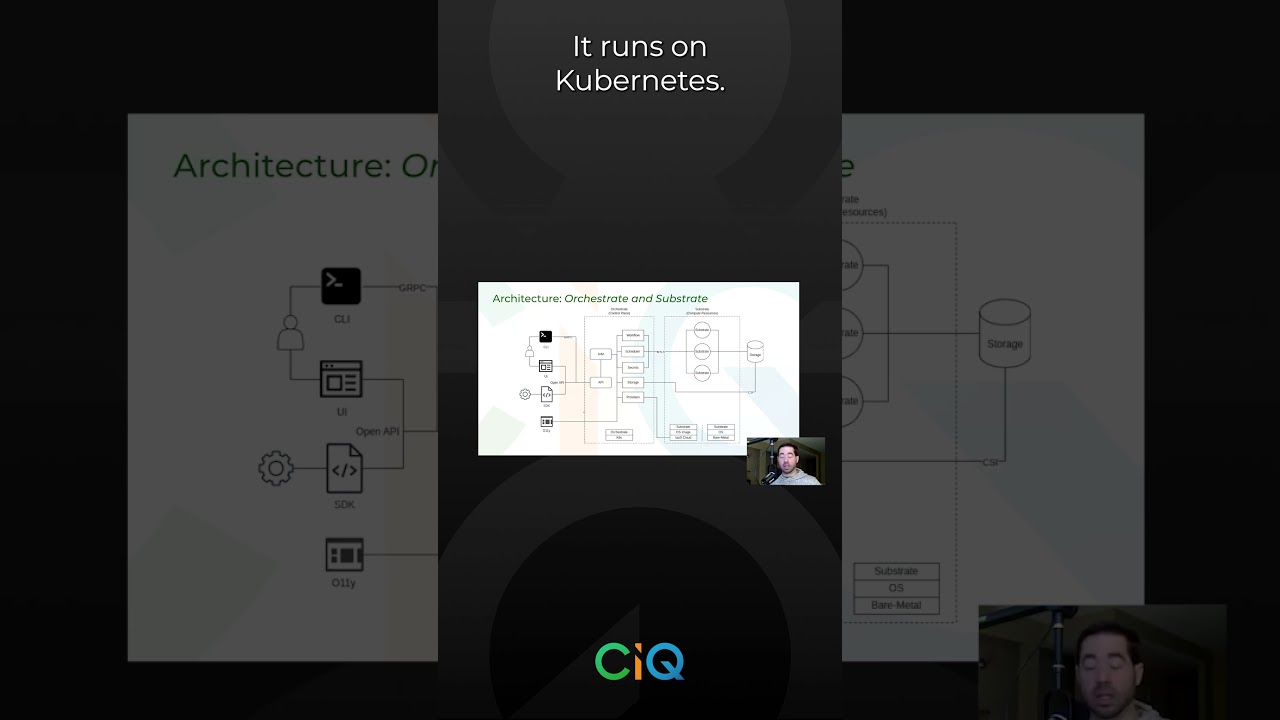
In this clip from a CIQ webinar, David Godlove introduces the overarching Fuzzball architecture using a diagram assembled by Jonathon Anderson and the Fuzzball engineering team, whom he credits throughout. The slide is dense, so he divides it into three panels and steps through them one at a time.
Before diving in, he addresses what Fuzzball is not. Fuzzball uses Kubernetes to stand up a cluster and runs on top of it, but it is not an attempt to make Kubernetes schedule HPC jobs. Nor is it a batch scheduler like Slurm or PBS; it has scheduling capabilities but does considerably more. The first panel centers on the user, who reaches Fuzzball through the web interface, the command line, or directly through the API using Python or Go bindings. Because everything is API-driven, teams can write their own applications against Fuzzball.
He also notes that Fuzzball exposes standard monitoring interfaces, so a site can plug in its preferred monitoring solution. CIQ uses Datadog internally, and Grafana is common in the HPC community. Administrators and platform engineers evaluating Fuzzball get a compact framing of where it fits relative to Kubernetes and traditional schedulers.
Key takeaways
- Fuzzball runs on Kubernetes but is not Kubernetes retrofitted for HPC, and it is not a batch scheduler like Slurm or PBS.
- Users reach Fuzzball through the web UI, the CLI, or the API directly via Python or Go bindings.
- Everything in Fuzzball is API-driven, so organizations can write their own applications and integrations against it.
- Fuzzball uses standard monitoring interfaces; CIQ runs Datadog internally and Grafana is popular in HPC.
Questions this video answers
Is Fuzzball just Kubernetes for HPC?
No. Fuzzball uses Kubernetes to stand up its cluster and runs on top of it, but it does not try to make Kubernetes run HPC jobs. It also is not a batch scheduler like Slurm or PBS; it includes scheduling but is a broader, API-driven platform with web, CLI, and programmatic access.
This video is part of the Fuzzball playlist. Browse every CIQ video by product and topic.
Transcript
during the course of this presentation too I'm going to be I'm going to be demoing and sharing a lot of work some of the work is stuff that I've done myself but I mean the vast majority of it is stuff that's done by other folks and I just want to give shout outs throughout this entire you know demo to the fuzzball uh Team um and to folks you know who have done the kind of work that I'll be showing as I'm doing it so this slide you know I can't take uh credit for this this is put together by Jonathon Anderson um you know
with obviously help from the the engineers working on fuzzball and stuff so shout out to them as I present this so this is kind of a complicated slide and normally I would not just like you know take something like this and just kind of throw it all at you but don't worry I'm going to like kind of walk you through it and talk about this is the overarching architecture of fuzzball and what it looks like all right so I want to show you that we've got this kind of subdivided into three different panels here and I'm going to step you through each one of these
panels one after the next um one of the things that I hope to dispel uh you know I've talked a little bit about what fuzzball is I also want to talk a little bit about what fuzzball isn't and hopefully as I show you this you know one of the things a fuzzball is not is it's not just kubernetes you know we use kubernetes um to to stand up a fuzzball cluster it runs on kubernetes but we're not taking kubernetes and trying to make it run you you know HPC jobs and sort of like a a scheduling system or something like that that's not what we're
doing here and so I wanted to spell that it's also not like a batch scheduling system like slur or PBS it's got scheduling capabilities but that's not really you know it's actually quite a bit more than that all right so let me Focus your attention over here to the left so here we're looking at a user that's what this little icon is is a user um and this user is going to use either the user interface which I'm going to show you today or the command line interface which I might show you a little bit of as well and either way they're going to end
View full transcriptHide full transcript
up hitting this API so everything here is API driven or if you want you can just write code you can um use bindings in python or go or you know some other language that you like and then you can just program against fuzzball directly and write your own applications that use fuzzball because it's all apid driven and then another thing to note is that we use you know kind of like uh monitoring standards so that you can hook up your own monitoring solution with fuzzball um we use data dog internally I think raana is really popular in the HPC Community but you know whatever your
monitoring solution is you should be able to to do that with fuzzball as well
Built for scale. Chosen by the world’s best.
2.75M+
Rocky Linux instances
Being used world wide
90%
Of fortune 100 companies
Use CIQ supported technologies
250k
Avg. monthly downloads
Rocky Linux
9
Enterprise products
Spanning the kernel to the orchestrator
Have questions about your infrastructure?
Talk to a CIQ engineer about Rocky Linux, HPC, and AI infrastructure.