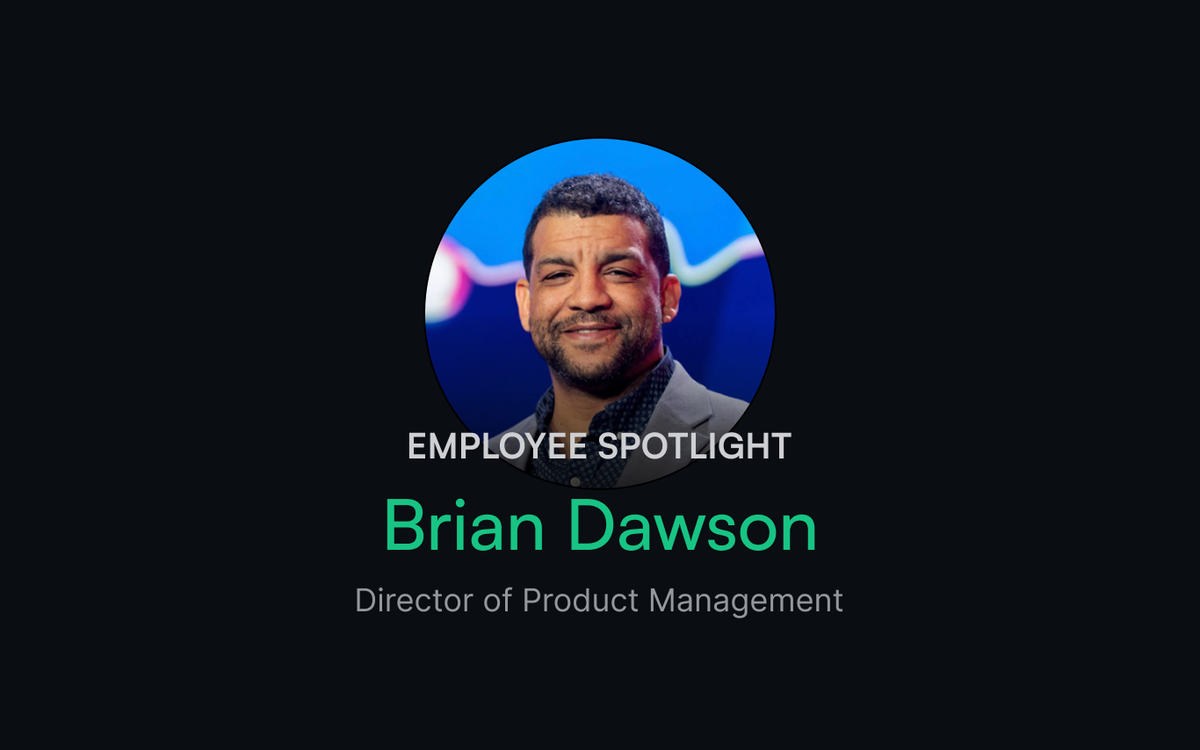
Ask Brian Dawson, CIQ's Director of Product Management, to explain what he does, and he reaches for a cake analogy before he reaches for a spec sheet.
Organizations have invested heavily in the most visible parts: the GPUs, models, frameworks, and applications. They have chosen the best icing and decided whether they want a strawberry layer. Then, when they reach the operating system, they treat it like ordinary flour and quickly put something together underneath everything else.
"We’ve moved so fast with AI that the OS has become the forgotten layer,” Brian says. “You’ve got this beautiful cake, and sitting in it is a slapped together layer of the OS because you weren’t thinking about it. But compromise that layer, and the structural integrity of the entire stack suffers."
That instinct to notice the layer everyone else is skipping past is the throughline of Brian's career, from helping developers work with matrix math on the original PlayStation to shaping the latest release of RLC Pro AI. It shows up in the questions he asks, the teams he builds, the reason he still DJs, and his belief that different perspectives reveal parts of a problem that others cannot see.
From matrix math to Rocky Linux
Brian’s path to product management ran through nearly every part of a technology organization, including QA, software development, DevOps, product marketing, technical sales, and community development. “I’ve had the benefit of being an individual contributor and a leader in every major phase, discipline, or domain of technology delivery,” he said. That breadth prepared him to approach his current role as what he calls “the CEO of the product,” responsible for the entire loop rather than a single slice, from translating customer needs into what engineering builds to helping marketing and sales communicate its value.
That habit of tracing how all the pieces fit together began in his first job at Sony PlayStation, where Brian was employee number 97. The console’s geometry transformation engine performed the fast matrix calculations needed to bring 3D graphics to consumer hardware at a level that had not previously been available.
Brian’s father worked at Silicon Graphics, helping bring high-performance graphics capabilities associated with supercomputers to technical workstations. At PlayStation, Brian encountered the next stage of that evolution as specialized graphics technology reached millions of consumers. Some of his colleagues later moved into the emerging GPU industry, whose processors would eventually become essential to modern AI.
In developer support, Brian sometimes traced a problem all the way down to assembly code before working his way back up through the system. He also created and managed a tools and middleware program at a time before widely available game engines gave developers a common foundation. The program helped technology companies build reusable libraries and tools so game developers did not have to create every component themselves.
Even then, his work crossed the boundaries between technology, product strategy, and communication. Because PlayStation’s early organization was small, Brian could sit in the room as the team decided not only what the technology could do, but also how to package and position it without overwhelming the audience with its complexity.
“We had this complex technology, but we couldn’t necessarily go out and market everything it did because that would confuse people,” he said. “I got exposure to how you take a complex technology and package it to go to market.”
Later in his career, Brian conducted what he calls “empathetic persona research,” sitting down with more than 50 developers and asking what motivated them, what frustrated them, and what they feared. One answer stayed with him: developers are motivated by seeing a user’s face light up when their work solves a problem. One of their fears is never seeing where that work goes or whether anyone benefits from it.
Brian recognized the same motivation in himself. He was originally drawn to programming by the ability to take an idea and create something where nothing had existed before. But what made the work meaningful was delivering that creation to someone who could use it.
He describes the thread across his career with a formula: innovate + evangelize + influence = impact.
Innovation alone is not enough. If no one recognizes what it can do, it remains an unheard tree falling in the forest. Evangelism builds understanding and belief. That belief creates influence, which ultimately allows an idea to produce an impact. Remove any part of the equation, Brian says, and the result is compromised.
Underneath every part is something simpler: none of it works without people who can bring other people, and the functions they represent, together around the same goal.
Looking beneath the label of AI
That broad view matters in AI because the word itself hides an unusually complex and fast moving system.
Start with the hardware: CPUs, GPUs, or other accelerators. Consider where that hardware runs, how many accelerators are involved, and how they are connected. Above the hardware are the operating system and drivers, mathematical libraries, AI frameworks, models, applications, and the business use cases those applications serve.
Then multiply that stack across engineering, product, finance, marketing, sales, and every other function exploring AI.
Asking whether an organization is “mature in AI” can be like looking at the finished cake and ignoring everything required to make it hold together.
“We put this really complex, multi-dimensional thing in a box and call it AI,” Brian said. His experience across the technology lifecycle helps him recognize those different dimensions and understand that changing one layer can create consequences somewhere else.
The operating system is one of the most consequential layers, but it is also one of the easiest to overlook.
Organizations devote enormous attention and capital to accelerators, models, and frameworks. The OS underneath them can become an afterthought, even though it connects the hardware to everything running above it. Driver compatibility, kernel capabilities, networking, system tuning, and resource management can all affect whether expensive infrastructure performs as expected.
At CIQ, Brian focuses on closing the distance between a general-purpose Enterprise Linux foundation and the operating system an AI workload actually requires. RLC Pro AI brings CIQ’s Linux and high-performance computing expertise into an integrated platform built for AI infrastructure.
Stability at the speed of AI
RLC Pro AI addresses what Brian calls an inherent tension between the stability of enterprise infrastructure and the rapid evolution of AI.
Enterprise Linux environments are designed for predictability. Organizations generally do not want the foundation underneath an important database or application changing every few months. In AI, however, a fundamental part of the stack can turn over within that same period. New hardware requires new drivers. Framework updates introduce new dependencies. Performance improvements depend on capabilities that may not exist in an older kernel.
Meanwhile, organizations are under pressure to put AI into production faster than they can develop deep expertise in every layer.
“How do we empower the people who have to work with it to have stability and performance, security and performance, vendor support and performance?” Brian asked.
RLC Pro AI answers that question in three ways. It combines enterprise stability with the performance required for AI workloads. It provides an opinionated foundation so teams do not need to become experts in every component before they can begin. And it reduces setup time so costly infrastructure can start producing value sooner.
Every moment a GPU remains idle while someone installs software, reconciles dependencies, or determines how to tune the operating system represents capital that is not being used.
The latest RLC Pro AI release expands how CIQ supports what Brian describes as the journey from experimentation to implementation to execution.
At one end, Ollama and a free developer container give an individual developer a quick way to explore models using a production-like software foundation. A developer can pull the RLC Pro AI container, pull a model through Ollama, and have a working local stack in about 10 minutes.
At the other end, CIQ Linux Kernel 6.18 provides a newer kernel foundation with vendor backing for large production environments, where small differences in performance and efficiency can become significant across many accelerators and workloads.
The aim is to support the same journey from a developer’s laptop to cloud, hybrid, physical, and rack scale infrastructure without requiring teams to assemble a new foundation at every stage.
“We’re completing the AI journey to meet people where they are,” Brian said.
Addressing pain points
Moving to a newer kernel is not as simple as downloading it. Every component must still work with the components above, below, and beside it.
During development of the latest RLC Pro AI release, the team repeatedly encountered what Brian calls “dependency hell.” A framework might require a version of Python that is not included in the standard operating system environment. A driver may not yet have an officially supported path for a newer kernel. Solving one compatibility problem can reveal another dependency elsewhere in the stack.
Another problem appeared only when the team tested the system on Azure. RLC Pro AI had booted successfully on physical hardware, virtual machines, Google Cloud, and AWS. On Azure, it began booting and then failed.
The team discovered that a driver Azure needed during startup was no longer included by default in the initial temporary filesystem used to bring up the kernel. The other environments did not require that driver, which is why the problem had not appeared earlier.
That discovery demonstrates why delivering a supported platform involves more than making a kernel or software package available. Individual components can work independently and still fail when combined in a particular environment. CIQ tests those intersections and resolves the problems before customers must diagnose them in production.
“If it hurts us, there’s a good chance that it’s hurting our customers,” Brian said. “The pain we take on is a clear example of the value that we offer them.”
It takes a village to see the whole picture
No single person can master every dimension of a stack evolving this quickly. Brian’s role is to gather knowledge from kernel engineers, AI specialists, hardware partners, customers, marketing, and sales, then connect those perspectives around the right problem.
“As a product manager, especially in this case, it is much less about me being an expert,” he said. “I have to extract knowledge from anywhere and everywhere.”
Brian describes himself as “incessantly, if not precariously, curious.” Although he was shy as a child and still considers himself shy, he can produce a seemingly endless stream of questions once a conversation begins. Those questions help him move across disciplines, uncover dependencies, and understand how a decision in one part of the system will affect another.
“It takes a village to execute,” he said. “But it also takes a village to understand, so that we can build the right thing.”
That belief extends beyond technical expertise. Brian is passionate about diversity because different backgrounds allow people to see different sides of the same problem. Differences in race, gender, class, geography, and experience produce perspectives that cannot be recreated by a team looking from only one direction.
“When you have people who can all look at a problem from their unique perspective, you get a fuller view of what the problem is,” he said. “It gives you a better chance that you’re going to come up with the right solution.”
Brian tries to support that principle by making himself visible as a person of color and by bringing what he describes as his “weird, quirky” authentic self to work. Showing up openly signals to others that they can bring their own identities and perspectives into the room. Outside of work, that commitment also led him to help build a national diversity-focused lacrosse team while his son played the sport.
Music provides another thread connecting Brian’s life and work. He and his brother began DJing when they were young, and an early Mac and MIDI equipment became one of his first meaningful routes into computing. He still DJs and makes music today.
The connection is not simply that both music and product management involve combining different elements. It is that technology has always interested Brian most when it enables people to create, whether the result is a song, a video game, or an AI application.
That is also what RLC Pro AI is intended to do. CIQ takes responsibility for the operating system layer, including much of the integration, tuning, and validation work surrounding it, so customers can focus more of their time and expertise on what they want to build above it.
Across Brian’s career, the recurring habit is seeing what other people miss: the low-level component behind a developer’s problem, the organizational connection required to move an idea into the market, or a perspective absent from the room. Today, it is the operating system underneath the AI stack.
Years after his first job helping developers to unlock matrix math on the original PlayStation, Brian is now helping organizations keep modern accelerators working productively. The technology is more powerful and the stack more complex, but his measure of success remains remarkably consistent: Did the innovation reach someone, solve a real problem, and make their face light up when it worked?