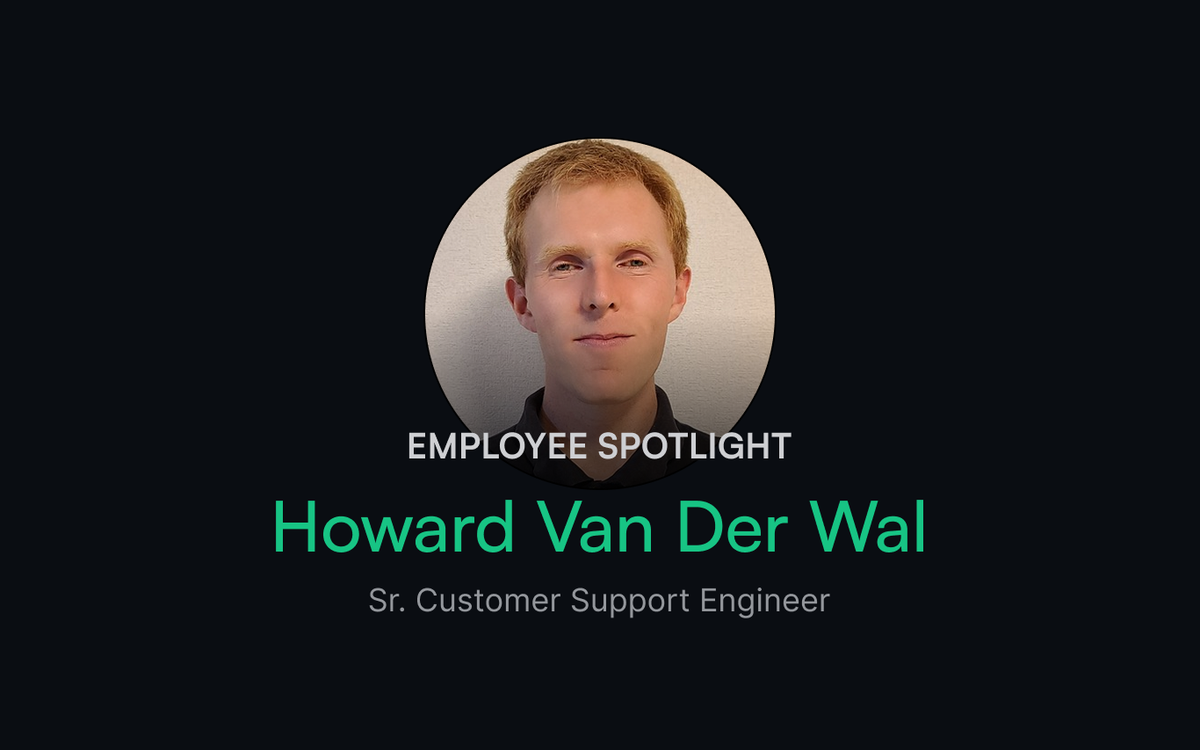
When Howard Van Der Wal encounters something that does not work the way he thinks it should, his instinct is to investigate. That might mean rebuilding a NASA workstation environment in Japan, recreating an uncommon IPv6 boot issue for a CIQ customer, packaging a television capture card driver for Rocky Linux, modifying a surfskate, or building his own shelves when the available options fall short. Across his work and hobbies, the process is remarkably consistent: understand the system, test what is possible, learn from feedback, and keep refining the result.
That instinct makes Howard well suited to his role as a Senior Customer Support Engineer at CIQ. It also helps explain why open source has become such an important part of his professional identity.
“Open source is the core of what I am,” Howard says. “I am grateful every day that I can work in this space.”
Rebuilding the problem, wherever it happens
Howard has tried what he describes as “every Linux distribution under the sun.” Along the way, he has learned to troubleshoot issues ranging from failing Kubernetes pods to audit logs slowing down a system.
That breadth is valuable in customer support, where each ticket can introduce a different combination of software, hardware, configurations, and operational requirements. It also makes Howard an invaluable resource for our customers and internal teams across CIQ.
“I’m more of a jack-of-all-trades type of person,” he says, which is ideally suited to our startup-like culture. When the Product team needs help preparing a new offering or Business Development encounters a problem on a prospective customer’s system, Howard is ready to investigate.
His work with NASA’s Flight Sciences Laboratory shows how far that investigation can go.
“The folks at NASA are always a pleasure to work with,” Howard says. “I have helped them with a variety of issues, ranging from troubleshooting their InfiniBand setup to assisting with a specific Podman configuration.”
One particularly challenging issue involved screen mirroring on Rocky Linux 8.10. In a dual monitor configuration using either GNOME or Xfce, the system would unexpectedly display the same image on both monitors instead of maintaining the extended desktop NASA needed.
The issue depended on a particular combination of hardware, drivers, desktop environments, and system behavior. To recreate NASA’s environment as closely as possible, CIQ purchased two Dell P2715Q monitors, an NVIDIA T1000 4 GB graphics card, and an NVIDIA A2000 12 GB graphics card.
Howard discovered that the problem appeared after a user’s workstation entered sleep. When the machine woke, the displays switched to mirroring.
Finding that trigger was only the beginning. Howard tested different NVIDIA drivers, adjusted GNOME dconf and Xfce profile settings, experimented with xorg.conf configurations, and continued looking for a reliable way to restore the intended desktop.
Ultimately, he developed two scripts for NASA. The GNOME Window Position Restore Script continuously saves the positions of open windows and restores them when the workstation wakes. The Xfce Display Profile Applicator applies a display profile across the system to restore the correct configuration while still allowing individual users to customize their settings.
“This was a very rewarding experience for me,” Howard says. “It allowed me to better understand the complexities of window management across desktop environments and the variety of configuration options available to users in the desktop Linux space.”
The experience reflects Howard’s approach to customer support. If a problem depends on a specific environment, he works to recreate that environment. If the cause is not immediately visible, he keeps testing until he can identify the behavior and develop a practical solution. Along the way, each customer challenge becomes an opportunity to understand another layer of Linux and bring that knowledge to the next problem.
Turning customer problems into community progress
Sometimes a customer issue also creates an opportunity to improve the underlying open source project.
CIQ works closely with the upstream Warewulf community, and several CIQ team members are Warewulf maintainers. CIQ customers bring novel and uncommon use cases that can expose where the software needs to evolve.
One such case involved a two stage dracut boot over IPv6. Howard analyzed the customer’s issue, built a test environment, developed and tested a solution, and submitted it to the Warewulf project. The resulting patch was merged upstream.
“It is amazing through my work that I’m able to help a customer and support an open source project at the same time,” he says.
That experience captures what Howard values most about open source. A solution developed for one organization can become an improvement available to an entire community. The engineer is not limited to using the system as it exists. They can examine it, change it, and contribute what they learn.
From using technology to reshaping it
Howard first encountered Linux at university, when a penetration testing course required him to use Kali Linux. His interest continued to grow from there.
“The open source methodology for me just outweighed the benefits of proprietary software,” he says. “It allowed me to have a passion for what I was doing and be part of something greater than I as an individual ever could be.”
That philosophy extends beyond Howard’s professional work. Across his interests, he is rarely content to remain only a user. He wants to understand what is beneath the experience and participate in improving it.
His Project TV: Rocky Linux Edition is a fitting example.
The project originally ran on Ubuntu because the driver for Howard’s television capture card was available only for Debian based systems. Kubernetes was not part of the initial environment, either. When Howard decided to move the entire project to Rocky Linux 10 and Kubernetes, he had to create the path himself.
Working with a frontier model and completing multiple rounds of testing, Howard produced an RPM version of the capture card driver. He then built an environment with one control plane and one worker node, deployed each application as a pod, configured Intel Quick Sync to accelerate video transcoding, and wrote an installation script.
The result was more than a personal media project. It became another opportunity to experiment, document what he learned, and share it with others. Howard later presented Project TV to the Tokyo Linux Users Group, where the audience offered several ideas for its continued development.
“I always believe I’m never the smartest person in the room,” he says, “so I gracefully accepted this feedback.”
That humility is an important part of Howard’s open source mindset. Sharing a project invites others to question it, test it, and suggest improvements. Feedback is not a judgment on the work. It is one more input into the next iteration.
Building with code, wood, and wheels
The same pattern can be seen in Howard’s woodworking.
After becoming disappointed with the quality of shelving available from retailers, he decided to build his own. There was just one complication: Howard had never considered himself particularly good with his hands.
“In the words of the immortal Jeremy Clarkson,” he wondered, “How hard can it be?”
The answer, Howard discovered, was very hard. But that did not stop him.
He mapped out the construction and used a frontier model to help develop instructions. He then turned those instructions into a physical object, learning how to use the tools, measure accurately, and determine where and how to drill. After completing his first shelf, he went on to build a larger modular version.
Woodworking gave Howard another way to explore a principle that also applies to engineering: guidance can accelerate the process, but it cannot replace experience.
An AI model could help him plan the shelf, but it could not develop the physical judgment required to build it. That came from using the tools, making adjustments, and improving through practice. In the same way, AI can help Howard analyze logs, research possible solutions, or generate an initial approach to a technical problem. His Linux knowledge remains essential for evaluating those suggestions, testing them, and determining whether they will work reliably in a customer’s environment.
Howard approaches surfskating with similar curiosity. What began six months ago as a new form of exercise has grown into visits to local skateparks in Japan, long-distance adventures, and modifications to his board.
Surfskating requires continuous movement and adjustment. The rider generates momentum by pivoting the board forward and backward, responding to its motion and finding a rhythm. For Howard, that creates a “zen state” of deep concentration.
It also reflects his tendency to explore the systems behind his interests. Riding the board was only the beginning. He wanted to understand its components, change the setup, and see how those changes affected the experience.
Finding the problem behind the experience
Howard’s lifelong interest in video games reveals another side of his engineering mindset.
Gaming offers him an opportunity to become immersed in a different world, but he has also experienced the industry from behind the scenes. During a period in quality assurance at Force Field VR in the Netherlands, Howard helped test games for the Oculus Rift and Samsung Gear VR.
Quality assurance and customer support share a fundamental objective: understand why the user’s experience is not working as intended.
Both require someone to reproduce unexpected behavior, examine the conditions surrounding it, identify the underlying problem, and communicate what needs to change. The visible symptom may be only the surface of a much more complicated technical interaction.
Howard has also contributed to gaming communities through writing. Years ago, he produced a series of articles about gaming on Linux for Cane and Rinse, and he hopes to return to writing about the subject.
Once again, participation matters. Howard loves to play games, but he also helps test them, analyze them, and expand the conversation around how they run on Linux.
More than a user
Across customer support, upstream contributions, personal Linux projects, gaming, woodworking, surfskating, and AI, Howard explores how something works, looks for opportunities to improve it, tests his ideas, and learns from the people around him.
That pattern is also what makes open source feel like home.
Open source gives Howard the freedom to look beneath the surface and the opportunity to turn individual discoveries into shared progress. At CIQ, he can apply that mindset to helping a customer solve an immediate problem while also contributing to the software that a much larger community depends on.
For Howard, technology is not something to accept as finished. It is something to explore, adapt, and improve, then share so someone else can take it further.
If you’d like to meet Howard, he invites you to send him a DM on LinkedIn.