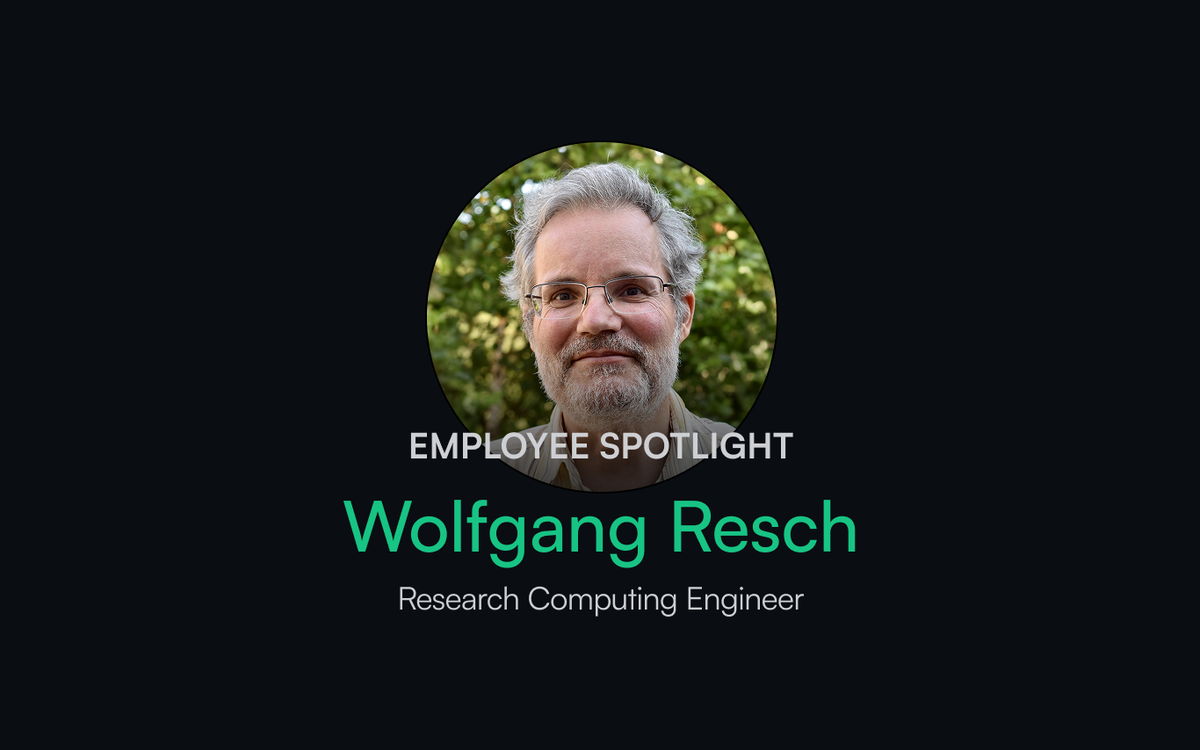
In 2001, Wolfgang Resch was studying HIV drug resistance when a biological question pulled him toward computation.
Researchers could measure a viral isolate’s clinically relevant characteristics through laboratory assays. But genomic sequencing was becoming faster and less expensive, and a growing collection of viral sequences had already been linked to experimentally determined results. Wolfgang and a colleague saw an opportunity: Could they train an algorithm to predict a virus’s phenotype from its sequence?
The resulting neural network became the subject of Wolfgang’s first computational biology paper. It also foreshadowed the direction his career would take, from experimental biochemistry and virology to bioinformatics, high-performance computing, and eventually Fuzzball at CIQ.
It was not a decision to leave science behind for technology. The science itself kept leading him toward increasingly complex computational problems.
“My career journey, in one way or another, has revolved around growing scientific knowledge,” Wolfgang says. “First by doing research myself, then helping others to accomplish their research goals.”
Following the science into computation
Wolfgang earned his undergraduate equivalent degree in biochemistry from the University of Tübingen in Germany before completing his doctorate in biochemistry at the University of North Carolina at Chapel Hill. His doctoral research focused on HIV-1 drug resistance, evolution, and fitness, with most of his time spent in the laboratory.
The neural network project began as something of a side investigation. Wolfgang had a problem that called for computational analysis, a colleague interested in similar questions, and a doctoral adviser who gave them the freedom to pursue it.
“Curiosity and an excellent work environment,” Wolfgang says, summarizing the combination that made the project possible.
After graduate school, he conducted postdoctoral research on pox viruses at the National Institute of Allergy and Infectious Diseases, part of the National Institutes of Health. His work remained primarily laboratory based, although computational analysis continued to play a role.
He then moved fully into bioinformatics, first at the National Center for Biotechnology Information and later at the National Institute of Arthritis and Musculoskeletal and Skin Diseases. The timing was significant. High throughput sequencing was generating scientific data at unprecedented rates, and the datasets Wolfgang analyzed required increasingly large computational resources.
As the data grew, his work moved closer to the infrastructure behind the research.
From conducting research to enabling it
Wolfgang eventually joined the NIH High Performance Computing facility as a support scientist. Over the next decade, he helped researchers select and run scientific applications, adapted open source tools for the NIH cluster, taught classes and workshops, and worked across storage, scheduling, system administration, and cloud resources.
The role gave him a view of research computing from both sides. He understood the questions scientists wanted to answer, but he also understood the systems, operational constraints, and specialized knowledge required to answer them at scale.
“HPC systems are large, complex beasts that require specific technical knowledge to avoid many pitfalls,” Wolfgang says. “Specific technical knowledge that researchers should not have to worry about, in an ideal world.”
Researchers were not only confronting the complexity of the cluster itself. They also had to manage growing volumes of data, preserve reproducibility, and accommodate emerging ways of working that traditional HPC systems had not necessarily been designed to support.
Interactive computing, persistent and shareable services, and containerized applications could be difficult to add to environments centered on conventional batch jobs. At the same time, administrators could not predict every type of research that would eventually arrive on their systems.
“As designers and administrators of HPC systems, we can never anticipate all the needs researchers will have,” Wolfgang states. “Systems need to be flexible enough to accommodate or adapt to unanticipated usage patterns, and administrators need to put the mission first and help the systems adapt whenever possible.”
That experience left Wolfgang with two principles that can be difficult to reconcile: research computing should be accessible to people with less infrastructure expertise, and it must give administrators enough control to protect a complex shared environment.
It also reinforced the value of having scientists, administrators, and engineers involved in system design. Each sees constraints and opportunities the others might miss. Wolfgang carries all three perspectives into his current role.
Bringing a researcher’s perspective to Fuzzball
As a Research Computing Engineer at CIQ, Wolfgang helps customers and partners deploy Fuzzball, gathers feedback about how it could better serve them, adds applications, and builds integrations with external tools. He also draws on his own experience as both a user and administrator of HPC systems to anticipate what researchers may need.
“There is a fine line,” he says. “Feedback from external users is very important, and we should avoid planning without enough feedback.”
Fuzzball addresses many of the challenges Wolfgang encountered at NIH. It combines familiar HPC concepts with useful ideas from container-based environments, allowing teams to define portable workflows that include their jobs, services, resources, code, and containers. Those workflows can run across local infrastructure, traditional schedulers, and cloud resources.
For researchers, that can make analyses easier to reproduce, interactive applications easier to deploy, and workflows easier to relocate when local hardware cannot accommodate a project. It can also reduce how much infrastructure knowledge a researcher needs before putting advanced computing resources to work.
Fuzzball 4.2 carries that goal forward by allowing AI agents to interact with the platform within permissions set by the organization.
“Allowing AI agents to interact safely with the Fuzzball platform will lower the barrier to entry for new users and significantly speed up the development of new Fuzzball workflows,” Wolfgang explains.
He sees opportunities to incorporate Fuzzball into existing agentic workflows and help administrators investigate cluster issues. The release also allows workflows to submit and manage other workflows, enabling more complex applications and simplifying integrations with workflow engines such as Nextflow.
CIQ’s work with Arcee AI shows how these capabilities can support emerging AI and scientific workloads. Arcee develops the open weight Trinity model family and is working to advance open weight models for science. The company uses Fuzzball to coordinate selected workloads across dispersed computing resources while retaining its existing training and inference stack.
For Wolfgang, the relationship is exciting both for the scientific work it could enable and for the feedback it brings to Fuzzball.
“Arcee has developed the open weight Trinity models and will push forward open weight science models, which will be crucial for accelerating scientific discovery,” he says. “It is exciting to see Fuzzball involved in this endeavor.”
Feedback from Arcee’s team has also helped CIQ develop a new way to incorporate dispersed and otherwise disconnected resources into Fuzzball clusters. It is the kind of exchange Wolfgang values: users bring real requirements, and those requirements help the platform adapt to work its designers could not fully anticipate on their own.
Keeping the mission first
While the tools have changed dramatically since Wolfgang trained a neural network to study HIV phenotypes in 2001, the underlying pattern has not.
A scientific question led him to computation. Growing datasets led him to bioinformatics and HPC. Supporting NIH researchers showed him how often infrastructure complexity stands between people and the work they want to accomplish. Now, at CIQ, he helps develop a platform intended to move more of that complexity away from the researcher.
His move into research computing has not ended his connection to biomedical science. In 2025 and 2026, Wolfgang had the opportunity to contribute to publications with a former postdoctoral adviser and another researcher studying components of the poxvirus entry fusion complex.
But he does not see infrastructure work as separate from scientific contribution.
“Supporting research computing does contribute to scientific research directly,” he asserts. “That is good enough for me.”
For Wolfgang, moving from the laboratory to the computing systems behind modern research has only expanded the ways he can contribute. With Fuzzball, he is helping build an environment in which scientists can spend less time mastering infrastructure and more time pursuing the questions that brought them to it.