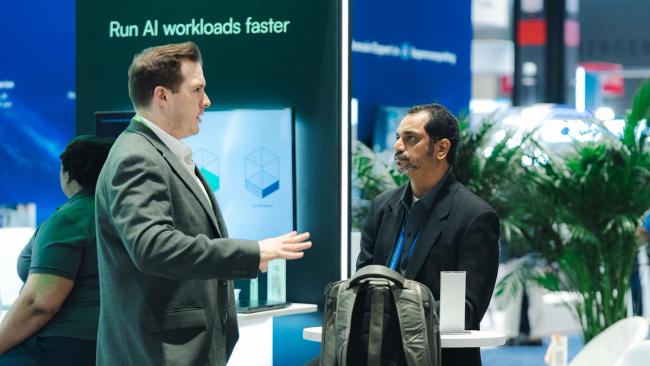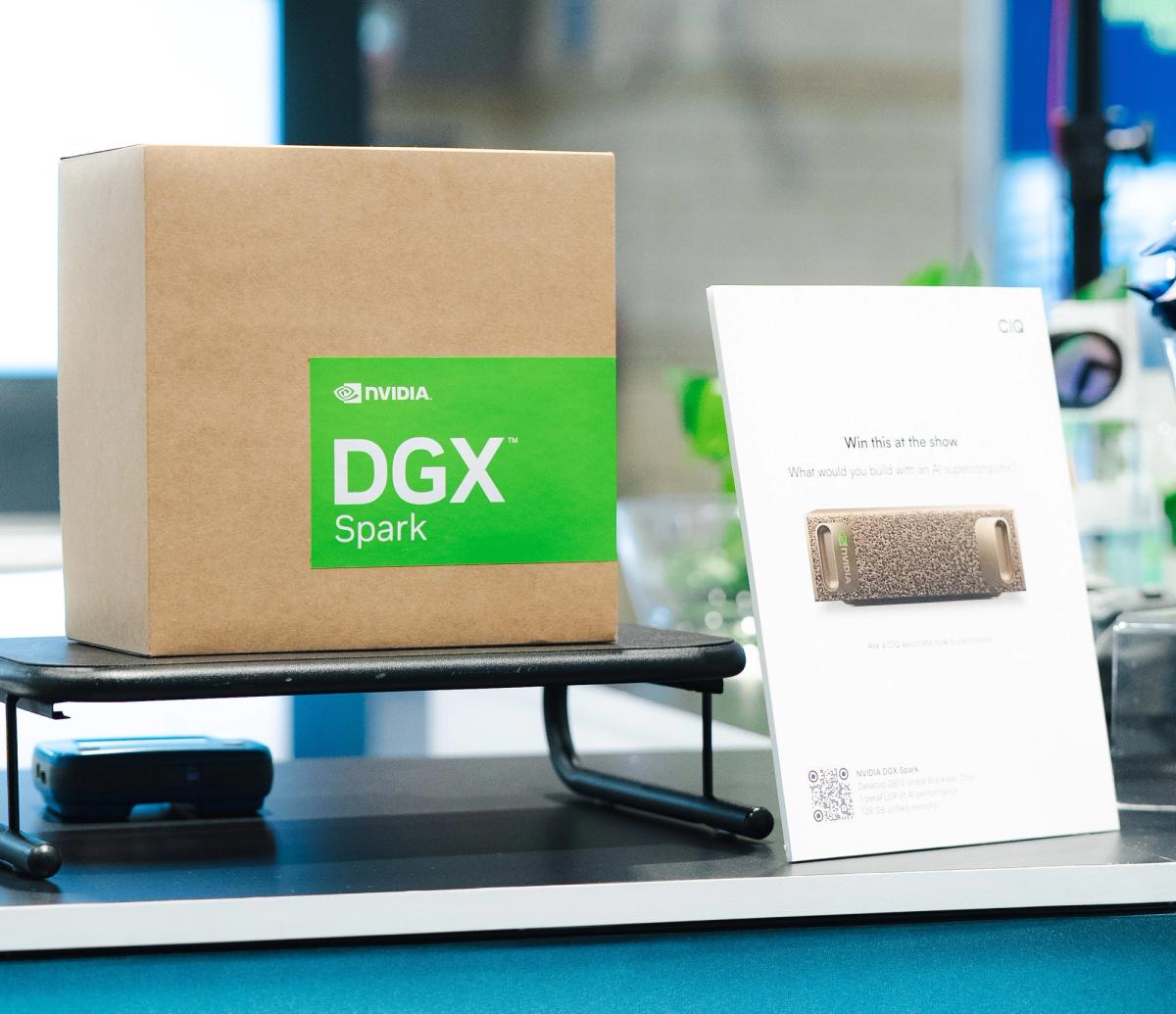
Nearly 500 researchers, engineers, students, and builders entered our SC26 DGX Spark giveaway. Ten ideas stood out for their creativity, technical depth, and fit with real-world computing needs, and Joe Hassell's idea earned the Spark, pre-installed with Fuzzball and RLC Pro AI.
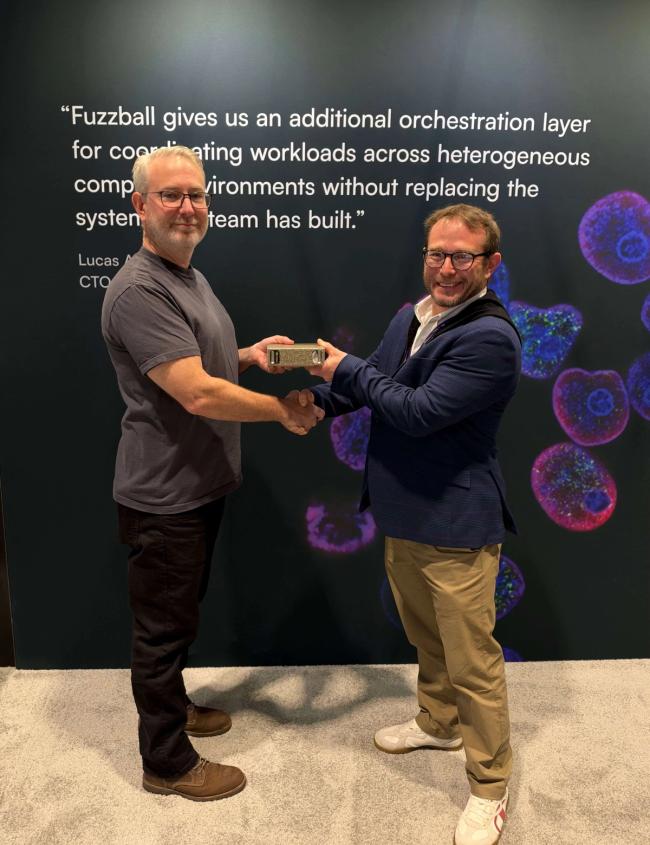
Meet the winner
Joe Hassell's winning idea protects native wildlife with a repeatable AI pipeline. New Zealand's conservation teams collect thousands of hours of forest audio and trail-camera footage, and most of it is never reviewed. Joe will use Fuzzball on a DGX Spark to ingest those recordings, fine-tune a sound-and-image model that tells kiwi, kākā, and ruru apart from stoats, rats, and possums, and shrink the model so it runs on solar-powered recorders in the bush.
Training stays local, so iwi, the local Māori tribes, keep control of data about their taonga, or treasured, species. New recordings trigger retraining each season, and rangers receive a nightly map of where predators are moving before the birds go quiet.
Three things made this idea stand out:
- It covers the full path from raw field data to a model deployed at the edge.
- It keeps sensitive data under the control of the people it belongs to.
- It tells a story that anyone can understand in one sentence.
Curious how Fuzzball workflows like this one are built? Start with the Fuzzball documentation.
Review the finalists
Nine other ideas made the final list, shown here in no particular order.
- Rebuild AI models in public: Rocky Linux proved that an enterprise operating system can be rebuilt from source in the open. This idea applies the same principle to AI models. One Fuzzball workflow builds an HPC operations-and-defense model from a public corpus, publishes an AI bill of materials, and lets independent sites re-run the build to verify the result. A dedicated Spark becomes the public reference builder.
- Break a supercomputer on purpose: Two open-weight agents play a game on the Spark. One injects realistic faults into Fuzzball workflows, such as corrupted checkpoints, out-of-memory kills, and flaky nodes. The other repairs them, and a fix only counts if the science output still verifies. The result is an open benchmark of failures that production machines can never crash on purpose.
- Audit privacy inside the hospital: Hospitals cannot pool patient data, and a trained model can leak who was in its training set. This idea defines an audit of hundreds of training runs once and runs it where the data must stay, in place of Slurm arrays on a shared university cluster.
- Generate flight software tests on-premises: Static analysis parses embedded C, a locally fine-tuned LLM proposes requirements-based test cases, containerized simulators run them, and coverage gaps feed the next round. Export-controlled code never leaves the building, and engineers review every test. The goal is to cut weeks of DO-178C verification work down to days.
- Staff a research lab with agents: A principal-investigator agent proposes hypotheses, experimenter agents launch Fuzzball workflows, and a reviewer agent rejects weak claims. The research question is what breaks when the users of HPC are agents, with bursts of speculative jobs, shared KV caches, and early cancellation of dead hypotheses.
- Rehearse repairs before they ship: When a service degrades, a local LLM infers the likely cause from logs and configuration snapshots. Fuzzball reproduces the symptoms in isolated replicas and tests candidate Ansible repairs. The system then applies the validated fix, verifies recovery in production, and updates users.
- Publish an open template for agents: This idea redesigns agent execution around network and compute, with auditable, reproducible provenance, for domain experts whose data cannot leave the organization. The result would be a published Fuzzball template that runs unchanged from a multi-node cluster down to a desk.
- Map 440,000 historic fire insurance sheets: A Fuzzball workflow aligns Library of Congress Sanborn sheets, which date to 1867, with modern maps. Text and building detection feed a fine-tuned vision model that reads building uses and matches addresses to city directories. The map, dataset, model, and code would all be open source.
- Cluster protein families from desk to supercomputer: This idea develops a workflow on the Spark and runs it unchanged on large clusters. The builder has benchmarked GPU clustering on 19.9 million protein sequences and has run a factorization at 0.67 exaflops across 65,536 GPUs on Frontier. The Spark's 128 GB of unified memory holds matrices that a typical home-server GPU cannot.
Spot the patterns
Across all ten ideas, four themes repeat:
- Data stays where it lives. Patient records, export-controlled code, and community-owned data all remain on infrastructure the builder controls.
- Build at the desk, run at scale. Almost every idea starts on a DGX Spark and moves unchanged to a larger cluster, which is the workflow Fuzzball is designed to support.
- Reproducibility is a feature. Verified outputs, AI bills of materials, and open benchmarks turn results that others can check into the product.
- Agents become users of infrastructure. Several builders want to know how HPC and AI systems should change when software agents submit the jobs.
Join the next round
Thank you to everyone who entered, and congratulations again to Joe. The next chapter starts now.
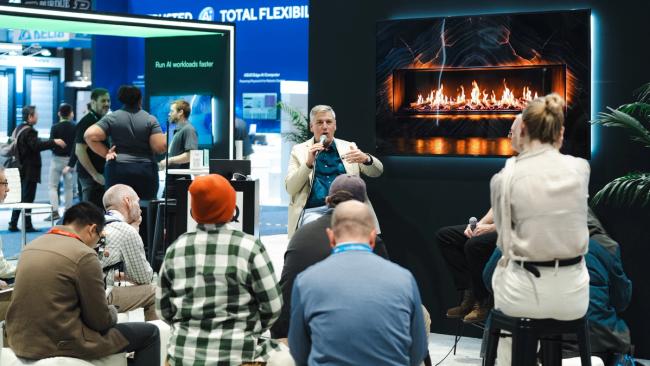
More hackathons and giveaways are coming in 2027. We will keep hosting hackathons like the Supercomputing Local AI Hackathon we held in Chicago this past weekend, and we will run additional DGX Spark giveaways at our 2027 events.
Get your Fuzzball developer license today. Visit portal.ciq.com to get a developer license for Fuzzball and start building your idea. Learn more on the Fuzzball product page and in the Fuzzball documentation.
Stay in touch with CIQ and watch for future announcements about events, giveaways, and hackathons.