Redefining what Enterprise Linux should be
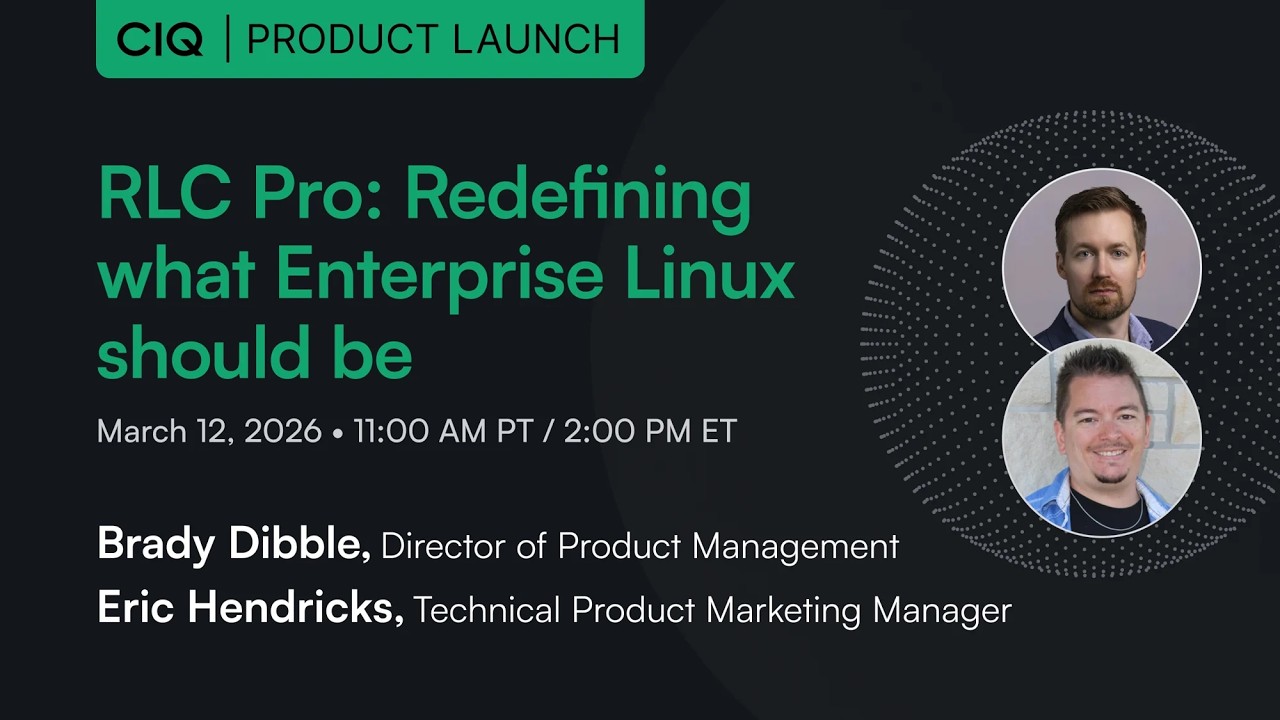
For too long, Enterprise Linux has been treated as a utility, something you pay for access to, not something a vendor is accountable for. When a bug hits production, you wait for upstream. When a CVE is disclosed, you wait for the patch cycle. CIQ built Rocky Linux from CIQ Pro (RLC Pro) to change that by making direct bug fixes, LTS, and FIPS validation standard features of the base subscription, backed by a vendor who stands behind your infrastructure.
Join Brady Dibble, Director of Product Management, and Eric Hendricks, Technical Product Marketing Manager, as they reveal how RLC Pro transforms what enterprises can accomplish with commercial Linux infrastructure.
Speaker
Brady Dibble, Director of Product Marketing, CIQ
Transcript
Good morning, good afternoon, good evening, wherever you may be hailing from. This is CIQ's bi-weekly webinar series recorded live on March 12th, 2026. Today we are talking about a question that every uh IT leader faces. who actually stands behind your Linux infrastructure. If you're not sure, then you've come to the right place. I'm your host today, Eric, the IT guy Hendricks, and joining me is our own Brady Dibble. Uh if I bring him into the stage here. Uh so Brady is our director of product management here at CIQ. So for those of uh that haven't met you, Brady, how about a brief introduction? >> As mentioned, uh Brady Dibble, thank you for the introduction, Eric.
I've been with CIQ for about two and a half years working primarily on our enterprise Linux products and as we have a broader portfolio how they integrate with the rest of our HPC AI and IT infrastructure products. >> Awesome. Well, I'm glad to have you with me because uh we gosh, what about two weeks ago now released RLC Pro uh along with uh with some other changes to our portfolio. Uh and we're going to we're going to discuss those at length today. But I I I want to start from a high level view. I I want to kind of take that 40,000 foot view, if you will.
Um uh so let let's kind of set the stage. Uh we're we're talking very heavily about uh enterprise Linux right now. Uh so what what is your perspective on the enterprise Linux market today? >> It's a great question. Enterprise Linux is essentially defined by stability and consistency and reliability and longevity. When a customer is planning out, especially the large customers we work with who are looking to use Enterprise Linux, they're planning out their infrastructure not in weeks, not in months, not in years, but in decades. and they're saying, "Is this uh is this OS that I'm going to be using as a foundation for my stack going to not only be around in a decade, but is it going to be stable?
Am I going to have an upgrade path? Am I going to be able to achieve my strategic goals when I build on top of this foundation? That that has been challenged with the growth of AI because that stability comes with a cost. That comes with a cost of you don't get features and you don't get functionality uh as quickly as you need to take advantage of the rapid development in the AI space. So businesses are torn between the need for stability and the need for consistency, the need for rel reliability with the need to be able to use the latest Nvidia GPUs and get access to the features and performance benefits that are tip of tree in the upstream.
View full transcriptHide full transcript
And that's where most of the challenges that I run into talking with our enterprise customers is how can they have their cake and eat it too? >> That's awesome. Uh yeah, I really appreciate that. um particularly the space around talking about how it people are planning uh infrastructure moves based on not years but even up into the space of decades. >> Um so that kind of brings up an interesting question around Rocky Linux. I mean Rocky Linux itself is everywhere. Um, and so we we've we'll talk about what these are a little bit later, but RLC Plus and RLC Pro have a a direct relationship with Rocky Linux.
Um, so how can how can that foundation help users uh uh who need a little bit more than than say just community? >> Sure. And the community Rocky Linux is fantastic and there's a reason why it's seen such growth and such use everywhere. It's this successor, the natural successor to CentOS as a a straight rebuild of enterprise Linux. That is what is there to do. And it's opinionated in that it isn't trying to reinvent the wheel of enterprise Linux. >> And and to butt in for just a second and clarify when we say CentOS, we mean CentOS Linux, the the former downstream of of Red Hat Enterprise Linux.
Just to clarify, not to be confused with CentOS stream. Absolutely not to be confused with CentOS stream but a traditional CentOS CentOS legacy however we want to uh say it is still of course being used everywhere um 20 over 25% of enterprises still use CentOS uh seven or sometimes even six um it's still a standard and it's uh very well established as a standard and even as that st uh standard matures there are expectations that you can use it everywhere uh and that you have a reliable ability to access that standard and deploy it. Rocky Linux as a community project carries on that legacy from CentOS so that you have a and something to put out and roll out and get your hands on Enterprise Linux, evaluate it or in many cases use it in production.
That is the beauty of Rocky Linux and that's why CIQ is the founding sponsor. Um, where we see customers, especially enterprise customers, run into challenges is they trust and love Rocky Linux because it is that reliable bug forbug uh enterprise Linux standard. Um, and then the moment they start from that foundation, they so they say great, I love that I have a solid foundation. Uh, but I actually now I want to change it.
say I love this bug bug and I know it but I want this bug to be solved or I want this enhancement from the upstream or I actually I love the fact that it's an independent community um which is a unique item it's a independent project it is not owned by CIQ it is sponsored by CIQ and the a lot of customers love the fact that it has that independence and they go that's great but I actually need accountability I need a vendor I can go to to get help um I need changes from that baseline uh from that stable baseline I know and trust
but it's not something I have the expertise to do or a desire to have something I build maintain over time uh with all those changes I need certifications that are very lengthy challenging and complicated to achieve like FIPS 140-3 or common criteria and that's where they need a vendor like CIQ and that's where RLC plus and RLC pro come into play is that is our product that is built on top of that trusted and loved foundation of Rocky Linux, but has all that functionality and all those features and value that enterprise customers really need. >> Awesome. Yeah. Uh and and you brought up one point that I want to I want to double click on for just a moment.
I don't want to belver it too long, but you mentioned that CIQ and this is a common misconception and I was just at at at the scale conference last week in uh Pasadena, California. Uh so if you were there, hi. Um but uh it it one one of the interesting things was people assume that CIQ owns and operates community rocky Linux but that's not the relationship at all. Can you uh can you expand on u what what that relationship actually looks like a little bit? >> Sure. And CIQ is the founding sponsor but there are many other sponsors that support the Rocky Linux project and the Rocky Enterprise Software Foundation which actually is what controls Rocky Linux.
So the RSF was started intentionally to have that distinction as a separate entity from CIQ. We're heavily involved in Rocky Linux. We support Rocky Linux. Uh we our engineers are in the mattermost. You can talk to them. Uh at the same time that separation is intentional. >> Awesome. And in fact, CIQ is not just a Linux company. We we also have uh we also offer tools like Ascender Pro which is built on Ansible AWX. We have tools like Werewolf Pro and Fuzball. Uh if you're involved in the HPC space >> yeah CIQ really started as an HPC company.
our founder um you know Gregor Kurtzer he built Werewolf uh which is a built on the original like Beaolf HBC cluster stack and it's still the you know keeps reinventing itself to say current as the go-to tool for provisioning HPC clusters and AI uh companies are finding that hey AI at that level is actually very similar to HPC and you don't have to relearn how to get maximum performance from your very expensive cluster you just reuse a a lot of the concepts and tools that were developed for HPC. Uh and so Werewolf and our Werewolf Pro product, Appainer, which is alternative to Docker for Docker for containerization.
Um and then fuzzball, which is our orchestration and scheduling tool for HPC and AI workloads. That's our foundation. Um we we really added on Rocky Linux because there was a a need from our customers to have that full stack and of course the situation with CentOS prompted the creation of Rocky Linux. Uh and so it's just naturally led to where we are today where customers want that whole stack from one vendor or much of the stack from one vendor and we can make sure that they get an integrated um product and platform. >> Yeah, that's that's great history and admittedly uh something I was confused about until I actually joined CIQ a few months ago.
So it's it's glad it's good to have that here and and and shared with with the community. Um, so le let's kind of dive into uh the the announcement that was made just a couple of weeks ago uh around uh the RLC line which is short for Rocky Linux from CIQ. So that's RLC and we have a few different offerings. Um so uh the first one is RLC plus it's it's free but it's not community. Can you can you kind of uh differentiate those two for me?
So CIQ works very closely with cloud vendors and hardware vendors and we we found that the to deliver the value um to ensure there's a build of Rocky Linux that works in the cloud across all the machine types and VM family options that has the functionality uh baked in a turnkey gold images that just work out of the box on the cloud and working with hardware vendors like Nvidia to have the easiest uh you know lowest time to first token the quickest time to get up and So customers do not have to deal with the complexities of uh dependencies around CUDA toolkit the the K
mods uh the drivers around NVIDIA GPUs DOA oped the container toolkit there are so many moving pieces in the matrix of how to get Nvidia uh and other hardware up and running and then you add the complexity of getting up on multiple different clouds. All of those things are very challenging frankly for a community uh to provide especially at the speed of enterprise. So CIQ as part of our partnership with the clouds and the hardware vendors have taken all of those uh the things we built the the processes the tools the automation and we've baked it into a layered it on top of rather a rocky Linux base and delivered it as RLC+.
So you can come to CIQ and you can get RLC plus or will soon and you can take that image and you can just go run it anywhere in the cloud or on top of the the latest hardware you need and you know that there's a vendor backing it ensuring that it's all compatible um and that when you run a DNF update and you get you know the latest CUDA toolkit or the latest data center driver it's not going to break because it's already been validated by CIQ to work together. Yeah, it's it's a really cool setup because it it's all built in. I mean, you take the ISO or you take the cloud image and you you hit deploy and it's already there.
You don't have to set up Nvidia drivers. You don't have to set up the Doa toolkit. You don't have to pull down all the different firmware and packages. It's all built into the operating system. So, all you have to do is just install it, start up the tools that you need, and you're you're ready to go. You're downloading your your model, you're downloading um you're you're starting to train it. it it saves you hours per server. And so if you've if you've got a cluster of, you know, dozens or hundreds of AI nodes, you're you're talking hundreds of hours in savings right there. It's it's a beautiful math uh math equation to run >> for some customers could be, you know, seven digits or more.
>> Uh because especially with um there are always gremlins in the details. Secure boot is an example of this gremlin. uh once you're dealing with uh certain NVIDIA software, at times you will have to disable secure boot to get DKMS to work. Um >> CIQ abstracts that all away. We uh have a partnership with Nvidia. We we rebuild, we sign, we deliver the K mods with a CIQ built version of the uh Rocky Linux kernel. And so the just works, all of that is headache is abstracted away. >> Uh as as a former systems administrator, I I love the phrase just works. means a whole lot fewer long nights for me.
Uh so who we we we kind of hinted at something that that uh I'll I'll announce at the end of the webinar. Um kind of an exciting day here at CIQ with a with a webinar and a new product release today. Uh but uh not to get ahead myself. Um we're we're talking about RLC Plus, which is not community, but it's not paid for. So who's the ideal RLC Plus user? Well, startups, uh, small businesses, students, um, during the supercomputing HBC cluster competition, for example, uh, 75% of the teams were using Rocky Linux. And that means they had to do a lot of the the work to, uh, to get that running and tuned for working on their NVIDIA or AMD GPUs and their clusters themselves.
Uh, RLC Plus would have saved them a lot of time and got them up to speed much faster. for you know enterprises for home labs for tinkers it's there if you do not have the expertise to um you don't trust claude to necessarily guide you in the right direction to get money but even for businesses um part of our partnership with the hardware vendors in the clouds is there are businesses who they just need a little more than they get from the uh the community version but doing it themselves is still not um the best idea so they can go take RLC plus it's free there are no limits uh to how much you use it you take it and boom you've got a build uh of Rocky Linux that is tested in partnership with the hardware vendor and the cloud and it just runs.
Uh so that saves businesses and enterprises a lot of time. Uh keeping in mind RLC plus is latest only. So the and it does not have that same u there's a there's a vendor behind it. There's CIQ you can come talk to >> but it doesn't come with support. It doesn't come with some of the features enterprises need like long-term support to stay on a particular minor version getting CVE patches. It does not come with BIP certified modules. It does not come with a a number of the other things that enterprises at scale actually need to deliver the strategic value they're looking to. Um if they have their own Linux team, great.
I mean part of CIQ's whole um open source policy or position is that it should be in like these are all open source things. So one thing to note every change that CIQ makes all of our code uh for like the kernel and for these modules is all open source. It's not even behind a login wall. If you want to get access to it it's all in GitHub. There is no like it is as easy as we can make it to get access to all of the source code. But if you are not in a position to build it yourself uh to handle the validation the testing if you don't have your own secure boot key which most people don't uh and that's where okay you can come to CIQ and it's available.
>> Yeah you uh you you definitely uh transitioned very well into uh into my next question. Uh RLC plus is is available from from the CIQ portal which we'll we'll demo here in a little bit. Um, and it's it's free. In fact, I use RLC Plus for a few personal projects. And in fact, I'm really looking forward to putting it to use as maybe a code dungeon master for my D&D group. Um, as as people know, I'm a big D&D junkie. Um, and so hosting my own model to to be a codem with me uh sounds like a fun use case, but uh um but that's that's not the same offering that I would use if I were running a multi-million dollar uh enterprise.
Uh but that's where RLC Rocky Linux from CIQ Pro comes in. RLC Pro. Um so where what uh what's the differentiation between just RLC Plus and and the Pro version? Pro is our single product that combines all the value that enterprise customers need instead of saying hey you know let's let's add from a whole menu of well I need enterprise Linux but I also you know need LTS but I also need FIPS but I also need you know this and that and there's this whole menu of checkboxes where you're debating which things you want to have. uh and then you end up with a very complicated matrix of which uh SKs and which licenses are running where in your system.
We are a customer first company and so our first thought is what's easiest for the customer, not necessarily what's best for CIQ because we figure what's best for you is going to eventually be what's best for us. So that means RLC Pro, what is it? It's it's everything you need. Um RLC Pro comes with uh LTS. It's not an additional add-on that you have to pay for or think about. It's just when you get RLC Pro, you choose from any of the active major version uh major versions, 8, 9, or 10. And then you also can choose from the existing supported LTS versions. So, uh, if you need FIPS, it's included.
That's that's right there. It's not an extra thing to think about. It's just a decision you make whether or not to enable that feature. And then over time, as we add additional functionality rather than them spinning off as additional add-ons, generally those are baked in. Now that is different of course from our workload optimized variants and that is also an interesting conversation because RLC pros is in uh intended as that strong foundation which is where you'll run most places. You run it in dev, you'll run it in production but increasingly there are uh more specific use cases that customers need. And what we what we see going into the future is that rather than just generic rocky, you know, enterprise Linux being the default and customers then have to do all of the work to take this foundation and they do immense amounts of work to tune themselves.
Increasingly that work is is challenging if you do not have Linux expertise and even if you do, we work with some incredibly technical customers who are very, you know, adept at Linux. That doesn't mean they want to be a distribution or do this work themselves. that ongoing maintenance and that ongoing research and adaption and buildout of functionality is something that CIQ specializes in. So even those technical customers come to us and say we have this repeating pattern of a way we are adapting and tuning um enterprise Linux for this use case and that use case and that's where our variants and overlays come into play like RLC ProAI and RLC Pro hardened.
>> So it's it's kind of almost like an inverted pyramid. Um, no, I said that backwards. I guess that would be a pyramid. At at the base, you'd have community rocky Linux and the enterprise uh the enterprise Linux development life cycle. Uh, and then on top of that, you've got RLC plus. And then on top of that, you've got RLC Pro. And then you mentioned some of these variants like RLC Pro hardened, which uh gets into the the realm of FIPS and disig compliance out of the box. So it it it just builds upon itself and so that our our customers or even our community members uh can can go in and use what they need, pick the variant that works best for them without having to deploy a general purpose operating system and then fine-tune it after the fact.
>> Yeah. Having a gold image that had gets you 90 95% of the way there or more, uh it saves you time not just the first time you set it up, but also every time you have to make an update. for sure. Um, so one one of the questions that often comes up uh is is about accountability and that's that's kind of what we teased in the introduction was uh one of the reasons why you choose a Linux vendor is so that you have not not just the traditional support model, but also there there's some some legal accountability in there too. And this is another area that often leads to a little bit of confusion.
Um, so I I want to get you your definition here, Brady, of what is vendor accountability and what does that mean when you're running Linux in production? >> This is something that our founder Gregory Curtzer and CEO uh constantly talks about like the code itself is open source. Uh we want to that is the core here. It is open source and anybody can go take that code and they can go build themselves. Um, I think this is, you can also allude to a lot of of the conversations people have had about with claude. Oh, I can go make my own kernel, um, using claude and I can tune it to my needs and go run it in production.
You can >> that's if it was that simple, if that was the only value, if the only value was in the source code itself, then there there would be no need for companies uh that are backing it. The reality is there's everything around that source code is where a lot of the value comes from. Support, as you mentioned, knowing that when you hit a a wall that you or your team just can't solve. You have someone and you can get connected to them in minutes and get a resolution from someone who lives and breathes it. Uh or if it requires a a change, you can get that bug fixed and deployed and your team isn't having to carry a one-off uh you know, bug patch.
But there's all the other ecosystem around it that is on the business side, the operational side. Uh and that includes for example indemnification. When you're uh using open-source products, you need to know that someone is making sure that you're not getting proprietary code into that supply chain and if for any reason something did that you they had your back. So with RLC Pro, we have indemnification for all of the Rocky Linux packages that are being included in RLC Pro. So that is an additional indemnification above and beyond our base indemnification. >> That's awesome. U yeah, that's that's an important distinction. Uh especially if you're running in regulated industries.
>> Yeah, Cloud is not necessarily checking to make sure it's not injecting proprietary code and if anything got in there be like you're absolutely right. Good luck. Right. >> You You mean I couldn't file a lawsuit against the the my Claude uh AI instance? >> Pretty sure uh ask Claude to go read through the terms of service there, but probably not. >> There you go. Um, so if I'm running a different uh enterprise Linux distribution today and I really like RLC Pro and I really like the idea of these functionbuilt uh variants, what what are some of my migration paths? >> So one of the beauty of being part of the Enterprise Linux standard is that it is binary compatible and anywhere you're running Enterprise Linux today, the migration back and forth is relatively seamless.
There will be differences like there will be modifications you have to make for URL paths and the the OS release files my is going to have a different name. Uh but broadly enterprise Linux is a standard um CIQ is part of the open ELA with Oracle and SUSA and we use a tool called uh EL validated to validate binary compatibility of our products against the enterprise Linux standard.
So that gives customers a a baseline uh so that they know that when you know if you're going if you are running pro for example and you say hey you know what I need to go back to a rocky Linux community for whatever reason it is a very straightforward transition because they're all binary compatible if you are m you know on um any other enterprise Linux platform like Oracle Linux uh there that binary compatibility ensures you can make those transitions and a lot of your workloads are going to carry over and That's uh having that standard especially in the age of AI is particularly important
because you can always come back to that standard and ensure that you have that compatibility layer and that confidence that um what we see quite often for example with ISVS is that uh they they look at Rocky Linux and they say well it it it is standard with enterprise Linux so I feel confident that this is going to pass uh and that they will certify Rocky Linux alongside ongside other enterprise unexperienced because it's tuned in and follows that standard very very tightly. >> And and one point I feel like we should clarify is that you you you mentioned this but I wanted to call it out is that that uh that certification is not inherited that CIQ goes out for specific certifications for specific major minor versions and gets those certifications for ourselves.
Did I hear that correctly? >> And there's certifications and then there's certifications. Um for for the enterprise like for uh for ISVS and IHVs, hardware vendors and software vendors, um many of them will just rubber stamp and say, "Hey, Rocky Linux is it's following the Enterprise Linux standard. I've tested on the Enterprise Linux standard. So I'm confident that all of these enterprise Linux flavors or or distributions are all going to work equivalent. Testing one gives me confidence in the others. It's not everyone, but like with CIQ, when customers say, "Hey, uh, I want the I work with this particular vendor uh, and they aren't listing your product, great, come talk to us and we'll go talk to them together." And that's what we do today is work with vendors to get RLC Pro and Rocky Linux certified explicitly for customers who need that confidence.
um or you know with um when it comes to other types of certifications those also don't just transition FIPS 140-3 is an example uh FIPS 140-3 is highly specific it is per module so a single like essentially a single package like GNU TLS or libgrypt and if you are following the exact letter of the law uh it is a specific binary version that has been seen by the testing lab and only in a particular operating environment down to the specific motherboard and processor in practice. That's not how enterprises use it. Um, very few are leaning on the certified version. They are leaning on a compliant version.
Uh, that means they need CVE patches. Uh, because you have to now you've got competition between am I FIPS certified or am I following Fed Ramp for example to ensure that I'm keeping all of my CVES remediated. And that's where most customers use what we call compliant which is not an official term. Uh they use take that certified base and then they will use a version where CIQ is patching uh you know CVEEs but we're maintaining cryptographic integrity meaning we're not touch the cryptography that doesn't change. The only code changes are to patch those specific CVEEs and if a CVE patch were to affect cryptographic integrity we would not apply it.
Uh and that's the trade-off you have to make. Now that to that point, Rocky Linux uh like focuses on the latest builds. Every time when you certify a particular version of a module, you are certifying that version of the module and there's a certain delta that generally is acceptable for something to still be compliant uh with FIPS 140-3. But the moment you make a real like a minor version bump, it's a truly a different version. Um the kernel is a great example.
the kernel moving from uh Rocky Linux 9.6 to 9.7 that's a significant bump and if you if CIQ we got uh version 9.6 we are pursuing certification for that kernel version it does not apply to the 9.7 kernel version >> because of that delta CIQ would not guarantee any level of compliance there the delta is too wide um the cryptographic integrity is is not guaranteed there's too many changes we had to go through for 9.6 six, for example, and work with the lab to make changes and add patches to bring it up to compliance with FIPS 140-3. Uh, those patches, of course, are all publicly available as usual in our GitHub for anyone who wants to grab them.
But the the version of modules that are out in uh the Rocky Linux Community Edition, it is very hard for anyone to argue that they are FIPS compliant, certainly not FIPS certified. The delta is just too wide. Um so when an enterprise needs FIPS compliance they need to come to a vendor like CIQ um because they not only get the version that has been seen by the lab but CIQ handles things like the secure boot signing and the LTS and if there are any issues you've got CIQ backing it to fix those issues because FIPS uh and we've seen can have challenges in very very hypersp specific environments and you need to work with a vendor like CIQ to resolve those issues in partnership the lab to both maintain your FIPS compliance and resolve those types of challenges you may run into.
>> That was one of the most cogent and well put together answers to that question I think I've ever heard. That's that's having been in the Linux side of the industry for over 15 years now. So, thank you very much for that. We'll we'll have to cut that as a as a snippet or something. That was great. Um, so we we've got a bit of a hands-on demo today, but before we dive in, there were there were a couple of questions put forth by the audience, which by the way, if you are watching this live, feel free to put questions in the comments section, or if you are watching this after the fact on, say, our YouTube channel.
Uh, please make use of the comments feature, ask your question, and we'll have one of our experts here at CIQ answer it as soon as we can. Um, so the first question, uh, comes in from Eric. uh spells his name with a K, but that's that's all right. Um um so he asks that both RLC Plus and RLC Pro are available for free download and being updated, patched in a self-supported model, just no support or no updates also. What what is what does that look like, Brady? >> So for clarification, RLC Plus is free. Um and very soon you'll be able to go to portal.ciq.com, ciq.com, sign up, get a license, and start using it.
With RLC Pro, it is available with a developer license, meaning you can use it for your own personal non-commercial non-production use in your home lab or for evaluation. Um, for enterprises, however, even the self-supported model does it is a per node price or you can uh get it in the cloud marketplace very soon as a pay as you go option. So, uh, the CIQ does offer for RLC Pro a self-supported level, but then we also have a standard and premium support options on top of that if you are looking for that support option. >> Awesome. Perfect. Uh, and then Mike asks, is there going to be some pricing listed for these offerings at some point or do we need to contact sales for for that information?
>> There will be pricing uh at some point in the near future that is listed. Um, for now though, please do contact sales. They'd be happy to help you out. Awesome. Um, so we we've teased this a couple of times, this this idea of CIQ portal. Um, and I'm really excited about it. Um, I've got uh some some behind the scenes access uh that uh that we we can show off. Um, this this will be rolled out to the public uh in in stages over the next uh week or so and then new new features are are coming. But uh I just happen to uh have have uh some some behind thescenes access here.
Um so we are looking at portal.ciq.com which Brady has teased a couple of times. Uh and I'm logged in to to my organization. Um and we're looking at my dashboard right now. What uh what kind of things would we like to point out uh to to our audience? Ready >> portal is our new customer portal where we have kind of looked at how the experience has been historically and we are starting from scratch to say what would we want to design a customer portal for to get a customer to what they want as quickly as possible. There are so many moving pieces. There's so much information out there that um I myself can get lost when going through u software portals these days.
What am I like? If I'm just trying to get my product installed or get access to a product, if I just want to go where the heck do I find a QA 2 or an ISO or the containers, it can be a real journey and you often don't have a map. So, the first thing we're doing is making it easy um as part of our consolidation of products. You can click on catalog and the first thing you see is some options for our solution stacks. How you can combine our CIQ products um for certain use cases. For example, with AI and ML um we talked about what do you get when you combine Fuzzball, Werewolf Pro and RLC Pro.
Um but if you scroll down, you'll see our products and keep in mind we are going to go through rapid iteration. Um the we're doing constantly watching how users interact with the site and we're adding changes and new features based on where people run into dead ends uh or where you know there are questions. So if we look at for example RLC pro you can go ahead and uh get started and you we go straight to what we know what you want. you want to get started. If you already have a license, you just come down, you choose from a list of selections of, hey, what kind of image do I want?
Do I want to boot the image because I'm, you know, trying to do image mode and I need immutability or am I going to go run a VM in the cloud or am I just going to do it myself and you walk through this list and you're going to find, you know, everything is there. Which version am I going to be using? Uh which architecture am I going to be using? What type of uh do I want LTS, for example? It's it's a very fast drop down and decision tree to getting to the actual file you want and you don't have to dig through, you know, a bunch of different pages.
It's straight to the point. Uh if you click on the bottom, uh I think uh which one are we on? We on um hard. Yeah. Um you know, right now we're at we're uh repopulating our imag um for uh the portal as it's rolling out. I think this uh so we were saying hey you want to you want arch you want x86 um or you want our Nvidia optimized image out of the box uh you know there it is and you you scroll down a bit boom download it it's right there uh there's not much else you have to do over time we'll keep optimizing
this workflow to try to get you to what you're trying to do as quickly as possible and ensure you have all the information needed because you're busy uh and you need to have to dig through pages and pages uh to, you know, get running. >> And I, as small a thing as it is, I actually like that I I can go in and copy and paste the commands that I need to to get this information. >> So, it just makes it so easy to just come in and u and and just cherry pick. Boom, boom, boom. Version, architecture, VM type, variant, done. And within a >> go ahead.
>> We'll be adding more guides over time depending on the you know every everyone's using a different uh mechanism for provisioning uh or managing their their fleet. So we you know not everyone's using vert install especially at scale but it's there as an example of here's how you would install it um spin up the VM. >> Yeah that's great. And uh well we'll of course uh keep everyone uh informed as uh as new features are added. In fact um I'm excited to share that here in the next week or so there will be a blog and a video walking through step by step what each uh which each of these screens are and and how best to use it.
Uh I I know the guy who's working on the video and he he knows his stuff. He's he's he's pretty sharp. Um, so as as we're kind of coming to the the close of this webinar, I I want to help uh help our audience walk through a bit of a decision tree. So Brady, if if you wouldn't mind, I I'm I'm a customer and I've got some questions for you. Um, I just I need some help deciding where where I jump in. Um, how how would I decide between RLC Plus and RLC Pro? >> The beauty is you don't really have to decide at any given time.
you can go grab RLC plus in the very near future and go run with it and start using it. And the moment you decide you need LTS, you need FIPS 140-3 certified modules, you need additional compliance, uh you need that vendor throat to choke, um you can come and you can upgrade and the transition is incredibly simple. You can transition a node from RLC plus to RLC Pro with a pretty much a a single command. Um depot enable and then choose a particular version you're trying to enable. uh we try to make it as simple and seamless as possible to transition. That also means you don't have to make that decision right away, especially if you're trying to evaluate.
And then if you're an individual or evaluating it on a personal level, we try to make it as quick as possible to get access to a developer license for RLC Pro versus RLC Plus uh to go run it on your home lab or in an evaluation environment. >> Well, here's here's a tricky question for you, Brady. Can I run different tiers for different environments? >> Absolutely. Uh this is it's really at your discretion. Um the if you are running um as a business, you can run RLC plus uh wherever you want. That's the that's kind of the point. But if when you have environments that are uh needing LTS, they need FIPS 140- uh you know, they need that indemnification, then we have RLC Pro.
And RLC Pro is just part of the whole stack. Um the RC Pro is there to work and integrate with tools like uh Ascender Pro um in your production environment. But if you decide that you you know you're going to be moving towards RC Pro, the idea is you can run it everywhere. Um you don't have to have one version or one tier running in uh development and another in production and some on your database servers and some on your you know you don't have to split it. It's one version that you can run everywhere. makes life so easy. As as a systems administrator, I always had I always hated having to deal with uh selecting subscriptions, making sure they were in the right right pool.
It just it became kind of a mess. So, being able to run the same the same basic software at at different tiers, whether it's dev or production, DR, I I just one less thing I have to deal with. One of the decisions we made which uh is we're not tracking license inventory on the client side meaning when you go install RLC Pro the only thing you need is the authentication token to do an update and that's intentional from CIQ. Uh we we do not think it's customercentric to have to deal with license inventory tracking. It's one of the it adds so much complexity for the administrator to have to juggle all of those the inventory and all those licenses.
And when you're sitting there going, hm, I need to go provision 10 more license, you know, 10 more instances. It's not a question of hold on, let me go to procurement and get 10 more or let me go find a couple of instances I can deprovision. It's I've spun up 10 more instances. and when you uh you're going to reconcile that when you talk to your CSM or during your next re renewal is what did you actually use? So these are the types of we're trying to think about what life is like because we are also people using this we use our own products. Um you know >> we have uh CIQ has we have been there using the Linux in production at scale and we're thinking about what are your biggest headaches and how do we remove those.
>> That's awesome. Uh so what what about the variants? Uh we've got proh hardened and pro AAI. When do those come into play? We there are patterns workload specific patterns that every business has where they start with that generic plain fully functional very flexible enterprise Linux baseline and they say great now I've got to go tune it over days weeks years uh to fit my particular use case and then I got to fight with it and maintain it and I've got to be a Linux expert and maybe I've got some anible playbooks that I've got to run to convert a a new node every time to hit my threshold and then deal with any reconcile any new bugs that pop up.
It's it's a it's a real pain. Um so we recognize these patterns that increasingly enterprises are looking for workload specific optimization. Two of those particular use cases are security and compliance which is where we have RLC Pro Harden and the other is AI. Um AI is a big challenge from a dependency standpoint and from a tuning standpoint. uh for example uh PyTorch just PyTorch and Python by itself is already an incredible challenge to keep maintained compatible and working over each update in uh especially across the matrix of all the other software you need from Nvidia and elsewhere and having a gold image that is already tuned and validated and works across updates.
Uh then on top of that you add on considerable you know performance improvements um above and beyond that base enterprise Linux uh that save that's where you would want to get to and frankly not teams aren't going to be able to get to that themselves on the flip on the other side you have heavy demands in government and regulated industries and especially increasingly with AI every enterprise is under attack constantly because anybody can grab AI and just start attacking attacking you and uh it's the the script kitties uh you know on steroids at this point. So traditionally when people think hardening they think oh I'm going to go apply my CIS or STIG a security profile and run my SCAP guide and get a print out and I'm done.
I'm I'm hardened. But compliance is just the first step. Yes, I've got to check off the box for FIPS 140-3. Yes, I've got to check off the box and make sure that I'm STIG compliant. Um but that's when a CVE is out you're vulnerable for for days uh for months sometimes and during that period of time uh AI doesn't care like the threat actors don't care that uh you'll patch it eventually that type of reactive patching is too late uh so we are taking going beyond just reactive patching and compliance with RLC pro harden and adding proact uh proactive detection and preventative measures at code level changes So we modify certain core packages to harden them and cut off entire attack vectors.
We also add some additional packages like Linux kernel runtime guard which adds detection and prevention against rootkits. So you've got a container escape. Um most you know LKRG has a very strong track record of identifying and preventing container escapes from getting into root and causing unknowns amount of damage. Uh so it's a it's a it's a multiple you know a multi-sighted approach to you've got your compliance that you have to have but you're you've also got preventative measures that mitigate entire CWEs so that you are much safer while waiting for those patches to be available and then applied and then when things inevitably do escape
because there's there's no such thing as secure there's only more secure you have that detection piece um and that you know three-sided approach is the foundation of RLC Pro and it's built on very long journey in history um of security in the Linux space with our our lead uh solar designer and his work at open. >> Yeah, that's awesome. Um if there's one thing that infrastructure leaders could take away from today's conversation, what what would you want that thing to be? >> Say go to portal and go grab a copy of RLC Pro and go use it. And if you got questions, we're here. Awesome. Yeah.
And if you want to learn more, you can head over to ciq.com. And of course, if you want to uh get to portal, there's a big uh login button in the top right of uh of our website or you can go straight there to portal.ciq.com uh you can create an email-based login or I think we support Google and one other that's escaping me at the moment. GitHub. Thank you. Yeah. Yeah. Um um let's see. All right. So, we've we've got a couple of questions um that may or may not that we may or may not be able to answer, but we'll we'll give it a shot.
Um Eric asks if there's any plans to expand expand CIQ bridge uh to other distros. So, beyond just CentOS Linux, >> we have had questions about that. um I won't name any particular distros but there have been certain very large distributions which are uh aging and getting along with a tooth and uh the transition away from them is not exactly a onetoone transition. So we actually we certainly have had those questions and if you're looking for a particular distribution to be supported please come talk to us. Um the it really is about the the number of customers who are demanding it. Right now CentOS still is the the uh the elephant in the room for most businesses, but it's not the only one.
>> And I I've got an answer for this one, but maybe uh maybe you know maybe you know better than I do. Uh so uh we we have a question about any plans to add butterfs support out of the box like on the Linux. >> We get that question a lot. Um the short answer is yes, we have been exploring it. Uh it is something we're talking through with a number of customers to what that implementation would look like and I'd love to hear from you about particularly where you're looking to apply it, why you chose Butterfest and which versions you're looking is this something where you need LTS.
uh it's it's not something where it's a a uh apply everywhere across the board situation. Um but for you know certain use cases, it's something we would love to entertain. So please come talk to us uh contact sales or hit up info@ciq.com and we'd love to uh get in touch. >> Awesome. Um all right, so uh Brady, I really appreciate you joining me today. This was an awesome conversation and as always I learn things about Linux and our products by by hosting these. Uh so uh there there's no better way to learn about something than to try and teach it to someone. Um but uh I I I teased this at the start but we actually have a new variant that just launched today.
So there is a press release out on our website. Uh we have officially announced RLC ProAI. So, we we kind of talked about that pyramid of um we we kind of uh talked about that pyramid going from community to RLC plus to RLC Pro and we've got RLC Pro hardened which actually there was a webinar last month that uh I think it was my first CIQ webinar. Uh we talked about RLC Pro Hardened uh at at at length. So definitely check that out as well as the LKRG demo uh that was uh a part of that uh webinar. But RLC ProAI is live now. Uh it's been in tech preview for a bit, but it is now GA and there are images available.
Uh and as you saw during our portal demo, you can you can actually download RLC ProAI today. Uh I'm really excited to get my hands on it and uh and play with it now that uh now that it's uh GA. But um yeah, check out uh we we've got a blog and a press release. Uh there are videos uh upcoming. And in fact, if you are free on April 2nd, uh make sure to join us right here for another uh another webinar. Uh we'll be talking about maximize the throughput of your AI infrastructure. So we'll be highlighting highlighting RLC ProAI. We've got a couple of industry experts uh and uh and one of our engineers that has been really really working hard on RLC ProAI.
Uh we'll have a live demo and and a spirited conversation about uh when you'd want to use RLC ProAI. Um Brady, any any thoughts about uh today's launch. Pretty cool that it coincided with our webinar. >> A lot of the value is in the user space, especially for AI. Um you're dealing with NVIDIA software stack. uh you're dealing with, you know, PyTorch, TensorFlow, Onyx, Hugging Face. All of these things can make people's eyes spin, especially the CIQ Linux kernel is what I'm most excited about. The CIQ Linux kernel is the default kernel for RLC ProAI, and that is based on the upstream kernel.org or long-term kernel tuned specifically for AI and then uh built to work uh fit right in to that enterprise Linux user space.
So you get all the benefit and stability uh and compatibility of the enterprise Linux user space but we're able to bring down a lot of the functionality that customers are just they have to have to meet their goals with AI to use the latest hardware but also use absolutely mandatory features like common criteria. If you're looking at something like Intel TDX uh or connect and like you must have com for multi-tenant environments, you cannot get that without moving to the upstream kernel and CIQ brings that and bright and a gold image on a silver platter so you can get the latest uh these these features that are mandatory to stay competitive in this day and age.
>> That is awesome. Yeah, it's it's such an amazing tool and I'm really excited to uh to be uh bring that uh webinar with you or uh to to you all. I speak for a living. Can you tell? Uh so definitely head over to events.ciq.com and you can hit the webinar registration. Of course, the link will also be in the description below. Uh so definitely head over to um to our webinar registration page and and uh book your seat for that. Um luckily seats are not limited. So, uh, feel free to, uh, to register and join us either live. Uh, we can take your questions on air or after the fact, um, on our YouTube channel.
Uh, in fact, uh, I've got probably a dozen or so videos that are in various stages of completion, uh, talking about Fuzball, talking about Ascender Pro, talking about RLC uh, Pro, RLC Pro AI. So, we've we've got a wide variety of topics coming to our YouTube channel, so make sure to head over to YouTube and subscribe to our channel there. Um, and if you are watching this after the fact, make sure to hit that like button so we know that this content resonates with you uh as we're we're busy uh not only releasing new products but releasing new marketing content as well. Um, that just about brings us up to time.
So, I really appreciate all of you joining us either live or after the fact. And, uh, Brady, thank you very much for being my guest today. It was a great opportunity to to pick your brain and share your knowledge with others. >> Always fun to talk to you. I look forward to our next one. >> For sure. I'll I'll uh I'll take that as a volunteer and uh and uh make make sure I get you booked again real soon. All right, everyone. Thank you so much for joining us and until April 2nd, we'll see you next time.
Built for scale. Chosen by the world’s best.
2.75M+
Rocky Linux instances
Being used world wide
90%
Of fortune 100 companies
Use CIQ supported technologies
250k
Avg. monthly downloads
Rocky Linux
9
Enterprise products
Spanning the kernel to the orchestrator
Have questions about your infrastructure?
Talk to a CIQ engineer about Rocky Linux, HPC, and AI infrastructure.