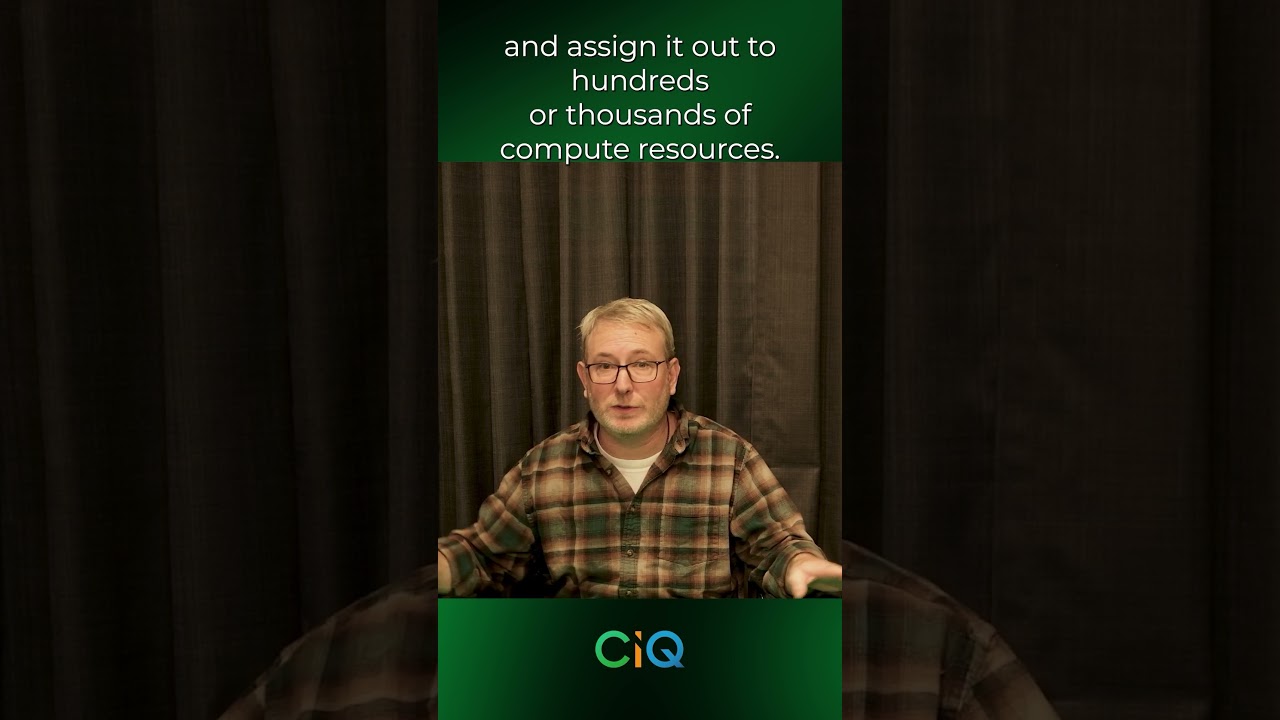
Warewulf creator Gregory Kurtzer answers two common questions: what is Warewulf, and where does the name come from? It is a software implementation of the Beowulf cluster architecture, hence the spelling. He built it after being tasked with standing up several HPC systems while already busy, seeking a way to manage hundreds or thousands of nearly identical compute nodes.
Warewulf assigns a single image, or a group of images, to all of those nodes and is built around a non-persistent operating system: a node receives the whole image at power on and forgets it at power off. Warewulf 4 is adding the ability to write to disk soon.
Key takeaways
- The name Warewulf combines software with Beowulf, the HPC cluster architecture it implements.
- Kurtzer created Warewulf to manage many HPC systems whose hundreds or thousands of nodes are essentially identical standalone servers.
- Nodes boot a full image into memory and forget everything at power off, so nothing is written to disk.
- Warewulf 4 is soon gaining the ability to persist data to the hard drive.
Questions this video answers
What does Warewulf do?
Warewulf takes a single image, or a group of images, and assigns it out to hundreds or thousands of compute nodes so an HPC system with many identical servers can be managed at scale. Nodes boot the image into memory and hold no persistent state, though Warewulf 4 is adding optional writes to disk.
This video is part of the Warewulf Pro playlist. Browse every CIQ video by product and topic.
Transcript
woo what is Warewulf and where did this name come from the name actually comes from kind of what it is it is a software implementation of the beow wolf Warewulf originally came because I was tasked with building a bunch of HPC systems and well I was already kind of busy so didn't have a lot of time to to go and build these other systems I wanted to figure out is there a way that we can more optimally manage these HPC systems cuz an HPC system could have hundreds or maybe thousands of compute nodes in it when each compute node is a standalone serer for
all practical purposes but every one of them is pretty much identical to all of the others so how do we take that and scale that uh that was the whole point of Warewulf and uh Warewulf now allows you to take a single image or or a group of images and assign them out to hundreds or thousands of compute resources and it always was built around the idea of uh volatile volatility in the operating system or non-persistence which means that as soon as you turn it on it gets the whole image and you turn it off forgets who it was it has no context because everything
is written to memory nothing's written to the hard drive now we've extended that to the point where you can actually write things to the hard drive uh were 4 is going to be getting those features very very soon
Built for scale. Chosen by the world’s best.
2.75M+
Rocky Linux instances
Being used world wide
90%
Of fortune 100 companies
Use CIQ supported technologies
250k
Avg. monthly downloads
Rocky Linux
9
Enterprise products
Spanning the kernel to the orchestrator
Have questions about your infrastructure?
Talk to a CIQ engineer about Rocky Linux, HPC, and AI infrastructure.