Keep small problems small: automated patch management, built on Ansible
Ascender Pro keeps large server fleets healthy automatically. Problems get fixed before they become outages, auditors get proof without a project, and the whole automation lifecycle arrives already working together.
CIQ trusted by:
Meet Ascender Pro
Running Ansible at enterprise scale used to mean assembling a stack: a controller, an event layer, an audit trail, a content hub, with every seam between them yours to own. Ascender Pro ships the pieces as one platform, so when something breaks, the fix launches in seconds, before a small problem grows into an outage. And because every action records itself as it happens, the proof exists before the auditor asks.
Where Ascender Pro earns its keep
Reactive
Governance-first
The complete loop
What you get when the pieces already fit
Fix problems while they're still small
Answer the auditor the same day
Patch every region with one launch
Give automation content one front door
Keep every playbook you've written
Own zero seams
The systems behind Ascender Pro
Ascender Pro is more than the Ascender control plane. Five systems, one goal: a fleet that fixes itself and can prove it. Each covers a step the others depend on, and none of them is a separate line item.
The web UI, API, and task engine that runs your playbooks across the fleet. New at this launch: Federated Inventory, one job launch fanned across every region at once.
Listeners catch events from your fleet, rules match them, and the mapped Ascender job fires in seconds. Read the Reaqt announcement →
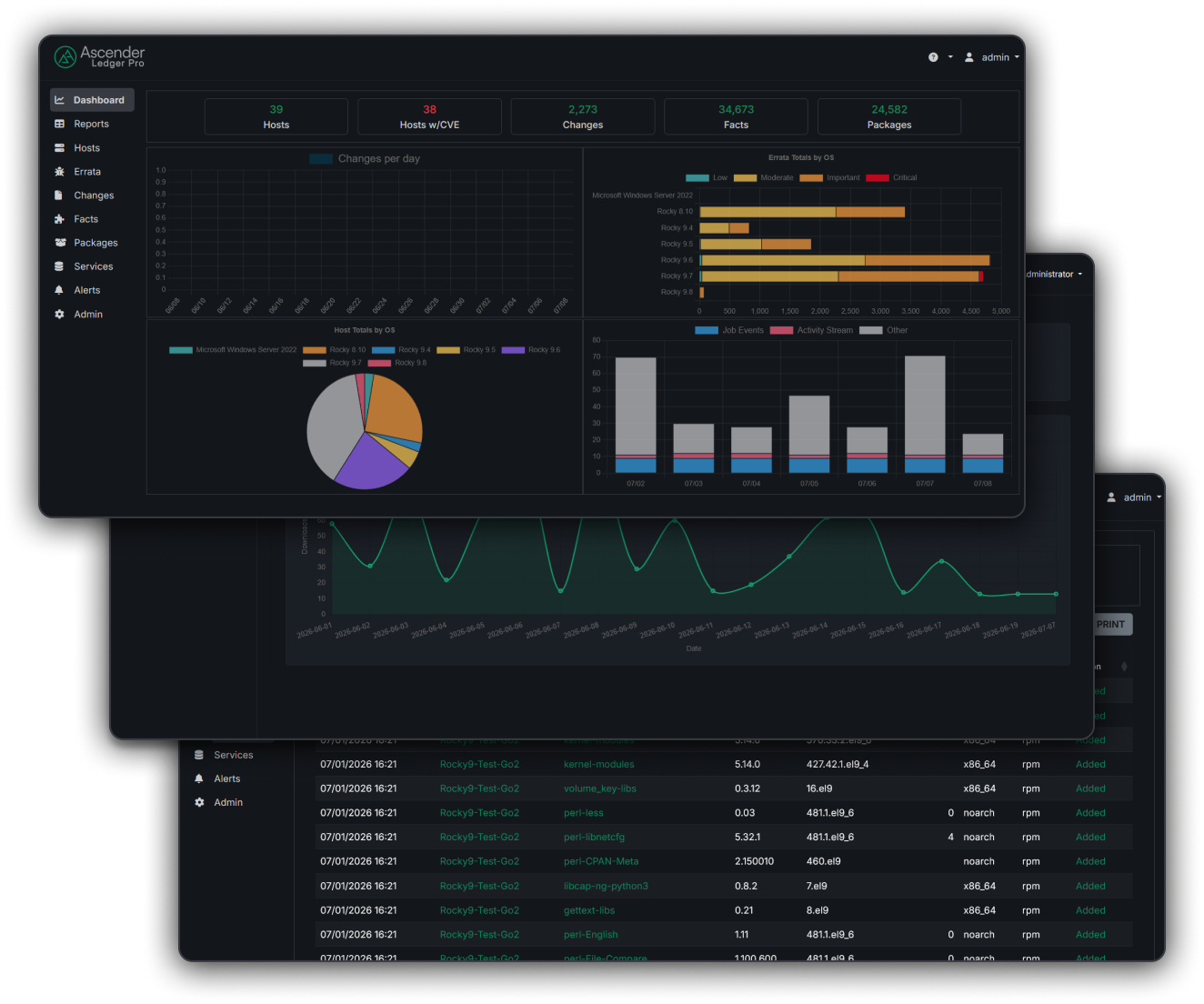
Logs what the platform itself does, so even your automation layer has a paper trail.
Stores and manages your Ansible collections and Execution Environments on your own infrastructure.
An authenticated, caching proxy between your fleet and galaxy.ansible.com, so upstream content arrives through one governed path instead of a thousand ad hoc pulls.
Ascender runs the playbooks. Reaqt tells it when. Ledger writes it down. Registry and Galaxy Proxy feed it content.
One platform, one agreement, no assembly.
The problems it was built for
The 2 a.m. fix nobody ran.
The audit that took an afternoon.
The CVE patched everywhere at once.

Download the brief to see how enterprise automation fits together
The solution brief walks the full platform: how an event becomes a fix, how the audit trail builds itself, and how content reaches your fleet through one governed path.
Questions about Ascender Pro
Ascender Pro is CIQ's infrastructure automation platform for running Ansible at enterprise scale. It executes playbooks across large server fleets, reacts to infrastructure events with automated fixes, records everything it does for audit, and manages the Ansible content your automation depends on. The full automation lifecycle ships as one integrated platform under one support agreement.
Ascender Pro includes five components that ship together: Ascender, the control plane that runs your playbooks; Reaqt, event-driven automation that fires jobs the moment a matching event arrives; Ledger, the audit layer that logs what the platform itself does; Registry, a local hub for Ansible collections and Execution Environments; and Galaxy Proxy, an authenticated caching gate between your fleet and upstream Galaxy content. None of them is sold separately. They are capabilities of the platform.
Ascender Pro prices per node, counting only the real devices your automation manages, not inventory entries. That keeps the total smaller and more accurate. Playbooks, roles, and collections carry over without retraining, since both platforms run the same Ansible.
A node is any device your automation actively pushes changes to: the endpoint your playbooks target via SSH, WinRM, API, telnet, or similar protocols. This covers servers, network devices, storage systems, and any physical or virtual machine under management. It doesn't include the infrastructure hosting Ascender Pro itself, or inventory entries that aren't actual devices, like a certificate pushed to a server. Simple rule: count the devices, not the inventory entries.
Yes. Ascender Pro runs standard Ansible: the same playbooks, roles, collections, and Jinja2 templating you already use, with the same agentless connection model. The control plane is derived from the AWX upstream, so teams coming from AWX, Ansible Tower, or Ansible Automation Platform keep their existing automation as-is.
Yes. Ascender Pro is the supported path for teams that have outgrown self-managed AWX or legacy Tower. You keep every playbook and workflow you have built, and you gain enterprise SLAs, 24/7 support, and indemnification, plus the pieces AWX will never ship: an event layer, a local content hub, and a platform audit log.
Federated Inventory lets one job launch fan out across multiple regional inventories automatically. Ascender splits the launch into simultaneous child jobs, each executing on that inventory's own instance groups, so every region runs the job on its own local execution nodes. Limits are honored, role-based access control is enforced across all source inventories, and no inventory sync is required.
Ascender Pro records who did what, when, and with what outcome as it happens, across every job, change, and automated action. Ledger logs what the platform itself does, and drift detection watches your baselines between runs. When an auditor asks for a quarter of production changes, the answer is a query against a trail that already exists, not a reconstruction project.
Ascender Pro is agentless and deploys in your environment. Registry keeps your Ansible collections and Execution Environments on your own infrastructure, and Galaxy Proxy caches upstream Galaxy content behind one authenticated gate, so your fleet's content path does not require internet egress. Regulated and restricted network segments get the same automation as everything else.
No. Ascender Pro is one platform under one license and one support scope. Reaqt, Ledger, Registry, and Galaxy Proxy are capabilities of the platform, not line items. Deploy what you need now and turn on the rest when you are ready, with nothing new to buy, learn, or renew.
Still have questions?