The question every enterprise team is now asking twice
One of the most important areas an organization must consider when selecting an operating system is vendor support. We're not just talking about when you need help with your OS, but how well it stacks up with the other pieces of technology you use. Does your chosen database run on it? Does the security of the OS meet your needs? What about backup agents? The HPC scheduler? Is the ERP middleware compatible?
The list goes on and on.
And now, you have to add AI into that equation. Does the GPU management layer run on it? Does the LLM inference stack? The vector database? The model training orchestration platform? The MLOps toolchain? What about the security stack, the HSMs, audit logging infrastructure, and cryptographic tooling your compliance team requires?
These are all crucial questions you must ask when selecting an enterprise-grade operating system.
None of these workloads run in a vacuum. They run on bare-metal, in containers, virtual machines, across clusters, and the teams deploying them need the same vendor support assurances that enterprise IT has always required. For organizations running RLC Pro (Rocky Linux from CIQ Pro), RLC Pro AI, or RLC Pro Hardened, those assurances need to be specific. These are differentiated products, built with capabilities that go well beyond a standard Enterprise Linux distribution. The question isn't whether RLC can handle these workloads. It can. The question is where to go to confirm the rest of the stack is compatible with it.
That place is c3.ciq.com.
What C3 is
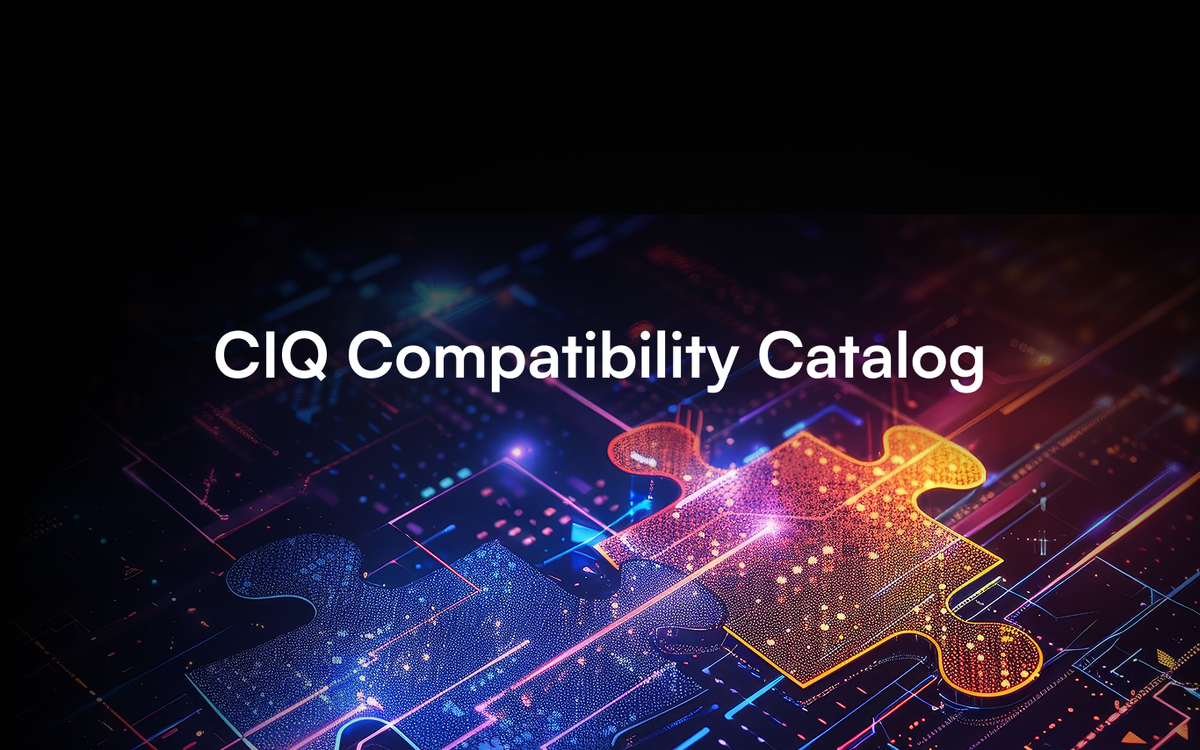
C3 is the CIQ Compatibility Catalog. It is the authoritative answer to "Does this run on Rocky Linux or RLC?" for hardware, software, AI infrastructure components, security tooling, and everything in between. Vendors run verification testing independently, self-attest to results, and publish their findings to a public, searchable catalog.
For enterprise IT and procurement teams, C3 provides a single reference for confirming vendor compatibility before standardizing on RLC Pro, RLC Pro AI, or RLC Pro Hardened for production workloads.
Use cases
The C3 platform is an entire ecosystem meant for real hardware. Here are some use cases that illustrate the wide spectrum of deployments that can be realized with C3.
| Use case | Primary audience | c3 command | Key value |
|---|---|---|---|
| Pre-purchase validation | Architects, Procurement | c3 info, catalog lookup | Eliminate hardware risk before PO |
| OEM certification submission | Hardware vendors | c3 test, c3 submit | Formal Rocky Linux certification path |
| CI/CD pipeline integration | DevOps, Platform engineering | c3 test, c3 export | Automated hardware regression detection |
| AI infrastructure validation | AI platform teams | c3 info, --only network | GPU cluster pre-flight |
| Compliance documentation | ISSO, Auditors | c3 export | FedRAMP/CMMC audit artifacts |
| Multi-site fleet consistency | HPC admins | c3 test, c3 list | Fleet-wide compatibility tracking |
| ISV certification alignment | Software vendors | c3 export + jq | Support matrix automation |
| Cloud/VM attestation | Cloud architects | c3 info, c3 test | Hybrid environment compatibility |
| Hardware lifecycle management | Ops teams | c3 test --only, diff | Safe hardware replacement validation |
| Home lab & DIY validation | Hobbyists, System builders | c3 info, c3 test | Confirm custom builds run Rocky cleanly |
Use cases
You're building private AI infrastructure and need a compatible stack.
When an organization trains a model on its own data, it's doing something without historical precedent: gathering the accumulated knowledge, processes, customer relationships, and competitive advantages of the entire business into a single concentrated artifact. During training, that artifact sits on a cluster somewhere. If that cluster is compromised, that organization isn't facing a traditional data breach. Instead, they're looking at a potential loss of everything the business knows, owns, and has been built upon.
This is why CIQ recommends RLC Pro Hardened for the training phase of any serious private AI deployment. RLC Pro Hardened is CIQ's hardened Rocky Linux product, that is built for environments where security and IP protection take precedence over raw performance. This platform is ideal for the training stage where the model isn't in production yet and a modest performance trade-off is acceptable.
What isn't acceptable is exposure.
Once training is completed, and the model or Retrieval-Augmented Generation (RAG) component is ready for deployment, the calculus changes. That's where CIQ's RLC Pro AI comes in because it is purpose-built for AI and HPC environments where throughput, GPU optimization, and workload efficiency are the priority.
Remember, production inference is a performance workload. To that end, your organization should train on RLC Pro Hardened, deploy on RLC Pro AI, and confirm that the rest of your stack is certified to run on both with C3.
Your security requirements go beyond the standard enterprise baseline.
Some deployments carry security obligations that standard Enterprise Linux doesn't address, like regulated industries, critical infrastructure, defense-adjacent workloads and environments where the cryptographic posture of the OS is subject to audit. RLC Pro Hardened addresses this tier of requirements. C3 is where security tooling vendors, HSM providers, and compliance-adjacent software vendors verify and publish compatibility with Rocky Linux and RLC Pro Hardened for customers operating at this level.
You have unusual hardware. Does it run on Rocky Linux or RLC Pro?
Not every deployment is a standard x86 server. There are high-density GPU nodes, HPC clusters, ARM-based inference hardware, embedded industrial platforms, and custom accelerator configurations, all of which need a validated OS foundation. If you've done the work to get Rocky Linux or RLC Pro running on specialized hardware, document it at c3.ciq.com. By working with C3, the next team facing the same deployment will benefit, and your hardware becomes part of the Rocky Linux ecosystem on record.
You're an ISV who needs a fast path to compatibility
Your customers are asking. Your sales team is fielding the question on every enterprise deal. C3 provides a low-friction path from "we support it informally" to a published compatibility record, starting with self-attestation against Rocky Linux, with structured paths to Vendor Verified and CIQ Certified for customers who need more. If your software runs on the Enterprise Linux standard today, you're likely already there. C3 makes it official for Rocky Linux, RLC Pro, RLC Pro AI and RLC Pro Hardened specifically.
You're an AI platform or tooling vendor.
The enterprise AI market is growing faster and faster with each passing month, and customers evaluating platforms (such as MLOps tools, vector databases, model serving frameworks, data pipeline infrastructure) are increasingly asking about Rocky Linux and RLC Pro compatibility as part of their evaluation criteria. When your product is listed on C3, it signals that it is ready for serious enterprise and HPC deployment environments. A C3 listing removes a real objection from enterprise sales cycles, and it doesn't cost much to obtain.
You're an enterprise IT team building a vendor support matrix.
Before you can get budget approval to standardize on Rocky Linux or RLC Pro for general infrastructure or AI workloads specifically, you need to show that critical applications are supported. C3 is the reference. Use it to check your stack, identify gaps and direct vendors to the verification process if they aren't yet listed.
You're a hardware vendor whose equipment is deployed in AI or HPC environments.
Your customers are running Rocky Linux and RLC Pro on your gear in production and they want that to be official. C3 provides the path to formal hardware compatibility verification, with options from Community Compatibility through CIQ Certified depending on what your customers require.
Get started
Go to c3.ciq.com. Select the path that matches your situation, from hardware certification, software compatibility, or ISV partnership, and begin your journey to official enterprise compliance. CIQ's team is available to support vendors through the process.
For organizations with questions about CIQ's enterprise Rocky Linux products, including RLC Pro Hardened for security-intensive training environments and RLC Pro AI for production AI and HPC deployment, visit ciq.com.
The Rocky Linux ecosystem is growing rapidly. C3 is how we document it, formalize it, and make it useful for the enterprise and research teams that need to act on it.
Start at c3.ciq.com.
Arthur F. Tyde III is SVP of Business Development at CIQ, the founding commercial sponsor of Rocky Linux. He serves as Chairman of OpenELA and previously served as CTO of the Free Standards Group and founding CEO of Linuxcare, the first commercial Enterprise Linux support organization. He can be reached via LinkedIn at linkedin.com/in/arthurtyde.